
P A R A S H A T B A L A K / C H U K A T – B A L A K
Numbers 22:2–25:9 • June 26, 2026 • 11 Tammuz 5786
Commentary by Michael L. Weiss, Ph.D., HCCP
When the Reflecting Pool
No Longer Reflects
――――― ◆ ❧ ◆ ―――――
This week we are going to do something a little different.
As many of you know — and as I have mentioned before, perhaps as both a warning and a promise — the Torah reading in Israel is currently one week ahead of the reading in the Diaspora. Last week I wrote about this parsha from the perspective of Israel’s calendar. But at some point, those of us outside the Land have to catch up, reset, and rejoin the rhythm of the Jewish world as it is being read here.
So this is that week.
Consider it my official “calendar adjustment.” No congressional hearing required. No executive order. No special counsel. Just one wandering Jew with a keyboard, a parsha schedule, and a modest desire not to confuse everyone from now until Simchat Torah.
Because I already wrote about this parsha last week, I want to approach it this week from a different angle — one we did not fully cover, but one that feels painfully relevant to the moment we are living through.
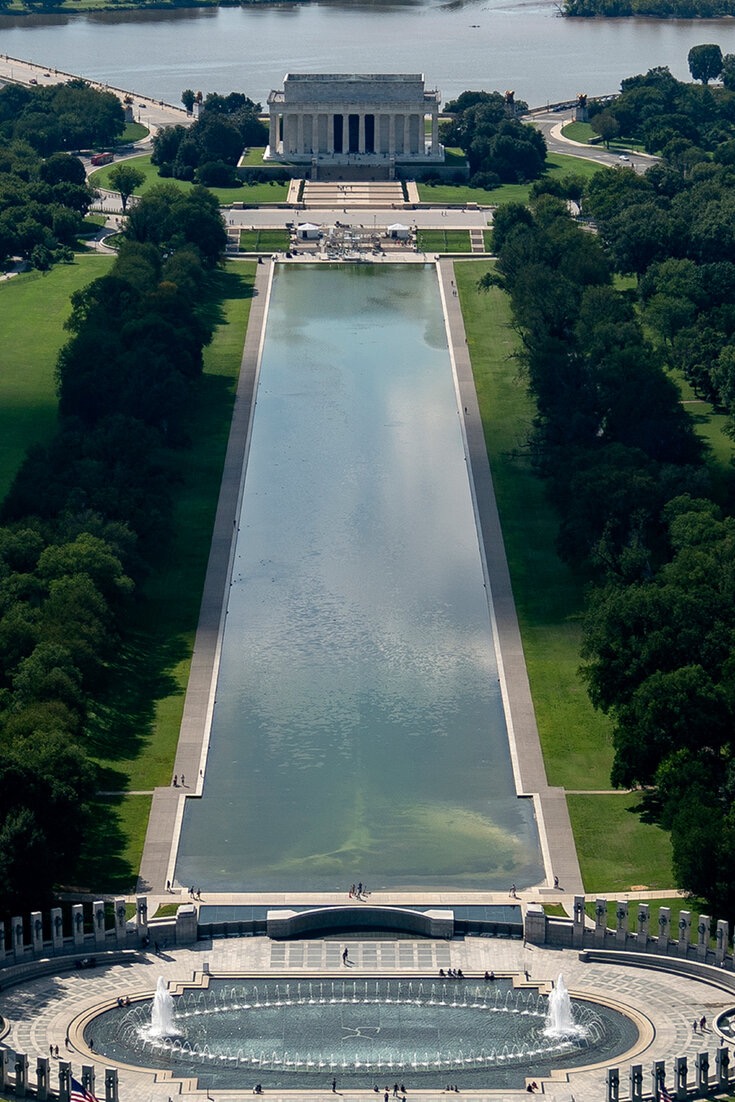
This week, America finds itself arguing not only about elections, voting rules, mail ballots, voter rolls, courts, executive power, and who gets to define the rules of democracy, but even about the Lincoln Memorial Reflecting Pool in Washington, D.C. Yes, apparently we have reached the point in our national journey where even the Reflecting Pool has become a political Rorschach test. One side sees vandalism. Another sees mismanagement. Some see symbolism. Others just see green water and peeling paint and wonder if anyone in government still knows how to hire a decent contractor.
As someone who has spent a lifetime around buildings, systems, failures, repairs, and people explaining why the thing that was supposed to work beautifully is now leaking, bubbling, cracking, or growing algae, I can say with some professional humility: sometimes a pool is just a pool.
But sometimes it is also a sermon.
The Lincoln Memorial Reflecting Pool was built to reflect something greater than itself. It reflects the monument to Abraham Lincoln, the man who held a broken Union together through blood, sorrow, moral courage, and language that still pierces the American soul. When that pool becomes cloudy, discolored, and contested, it is hard not to see in it a picture of our national condition. We are no longer merely debating policy. We are debating trust. We are debating legitimacy. We are debating whether the institutions meant to reflect our highest ideals still do so clearly.
And into this moment comes Parashat Balak, the strange and almost comedic Torah portion in which a frightened king hires a spiritual consultant to curse the Jewish people.
Now, as a general rule, when a king hires a prophet-for-profit to weaponize religion, we should probably assume things are not headed in a healthy direction. It is not exactly a best practice in governance. It would not pass a Chapel Foundation committee review, although I have sat through a few meetings where someone may have quietly wished for a Balaam-style intervention.
Balak, king of Moab, looks out at Israel and panics. The Israelites have not attacked him. They have not declared war on Moab. They are simply there — numerous, organized, moving forward, carrying a destiny that Balak cannot control. And so, like many insecure leaders before and after him, Balak decides that if he cannot defeat reality, he will try to manipulate the narrative.
He summons Balaam and says, in effect: Come curse this people for me.
The Torah gives us one of its great ironies. Balaam, the famous seer, cannot see what his donkey sees. The prophet hired to control words cannot control his own mouth. The man brought in to curse Israel instead blesses them again and again.
And then, from the mouth of this deeply flawed man, comes one of the most beautiful lines in Jewish prayer:
Mah tovu ohalecha Yaakov, mishkenotecha Yisrael.
How goodly are your tents, O Jacob, your dwelling places, O Israel.
We sing these words in synagogue. We teach them to children. We place them at the beginning of prayer. And we sometimes forget that they were first spoken by someone who intended the opposite.
That, too, is Torah. Sometimes blessing comes from the least expected mouth. Sometimes truth slips through the clenched teeth of those who meant us harm. Sometimes G‑d uses even Balaam, with all his ego and ambition, to remind Israel who we are meant to be.
――― ❧ ―――
A BRIEF SYNOPSIS OF THE PARSHA
――― ❧ ―――
Parashat Balak begins with fear. Balak sees Israel encamped near Moab and becomes terrified. Rather than approach Israel diplomatically, he sends messengers to Balaam, a prophet or diviner known for his spiritual power. Balak believes that Balaam’s blessing and curse have real force: those whom Balaam blesses are blessed, and those whom Balaam curses are cursed.
Balaam seeks permission from G‑d. At first he is told not to go. Then, after repeated pressure and perhaps a little too much enthusiasm on Balaam’s part, he goes — but with the warning that he may speak only the words G‑d places in his mouth.
On the journey, Balaam’s donkey sees an angel blocking the way. Balaam does not. The donkey turns aside, presses Balaam’s foot against a wall, and finally lies down. Balaam, in all his prophetic dignity, beats the donkey. Then the donkey speaks.
This is the part of the Torah portion where every rabbi secretly smiles. Because once the donkey starts talking, no sermon can take itself too seriously.
The animal sees what the prophet does not. The powerless creature understands the danger better than the powerful man.
Eventually Balaam reaches Balak. Three times Balak positions him on mountaintops overlooking Israel. Three times Balaam attempts to deliver the curse Balak paid for. Three times blessing emerges instead. He blesses Israel’s numbers, their strength, their future, and their dwelling places.
And then, as so often happens in Torah, the external threat fails — but the internal threat succeeds. Israel cannot be cursed by Balaam, but the people fall into moral and spiritual danger through idolatry and sexual misconduct with Moabite women. The parsha ends in plague, zealotry, and violence.
That ending should sober us. The Jewish people often survive the curses of others. The harder question is whether we survive our own loss of discipline, humility, and covenant.
――― ❧ ―――
THE CURSE THAT COULD NOT LAND
――― ❧ ―――
The Balaam story echoes the story of Abraham. G‑d tells Abraham that those who bless him will be blessed and those who curse him will be cursed. Later, after the Akeidah, Abraham is promised descendants, land, and that through his descendants blessing will come to the nations of the earth.
Balaam’s three blessings mirror those promises. First, he sees Israel’s numbers. Second, he sees Israel’s strength. Third, he returns to the language of Abraham: those who bless you will be blessed, and those who curse you will be cursed.
But the deepest point is not that Israel has some magical power over others. We are not spiritual traffic controllers deciding who gets blessing and who gets turbulence. We are not standing on a mountaintop with a tallit over our heads redirecting divine electricity. And if we were, someone would form a committee, hire a consultant, and within six months the tallit would be over budget.
The Torah is teaching something far more demanding.
Israel brings blessing to the world not by controlling others, but by living faithfully. Not by shouting louder, but by becoming a model. Not by cursing those who curse us, but by refusing to become what they say we are.
That is the genius of the Abrahamic promise. If Israel lives its covenant well — with justice, humility, compassion, learning, family, memory, faith, and moral courage — then those who bless that model open themselves to blessing. Those who curse it cut themselves off from the very values that could heal them.
This is not triumphalism. It is responsibility. We are not chosen to feel superior. We are chosen to be accountable.
――― ❧ ―――
WHAT THIS MEANS FOR ISRAEL
――― ❧ ―――
For Israel, Balak is never merely a biblical character. Balak is a recurring type.
Balak is the leader who looks at Israel and sees not a people, not a civilization, not a home, not a democracy trying to survive in a region that too often rewards brutality, but a threat to be removed.
Balak does not ask, “Who are these people?” He asks, “How do I stop them?”
That remains painfully familiar.
Israel is cursed in international forums, cursed in the streets, cursed on campuses, cursed in slogans by people who could not find Moab on a map but are quite certain they understand the Middle East after watching a ninety-second video. The Jewish people know what it means to have others assign us motives, identities, and crimes before we have even opened our mouths.
But Balak also teaches Israel an uncomfortable truth. The curse from outside is not always the greatest danger. Balaam fails. Balak fails. Their words cannot destroy Israel. But at the end of the parsha, Israel stumbles from within.
That is the warning.
Israel must defend itself. Of course it must. A nation that cannot protect its children cannot fulfill any moral mission. But Israel must also guard its soul. Power is necessary. Morality is sacred. Security is essential. Covenant is eternal.
The Jewish answer to Balaam is not merely strength. It is strength governed by holiness.
Israel must remain a nation whose tents are goodly — whose homes, schools, synagogues, courts, hospitals, soldiers, and leaders reflect the best of Jewish civilization even under unbearable pressure.
That is a high bar. But Sinai was never interested in low bars.
――― ❧ ―――
WHAT THIS MEANS FOR THE UNITED STATES
――― ❧ ―――
For America, this week’s parsha lands like a mirror held up to a tired republic.
We are arguing over elections before the elections even arrive. We are arguing over whether rules protect democracy or manipulate it. We are arguing over whether courts are guardians or obstacles. We are arguing over whether institutions still deserve trust. And in Washington, even the Reflecting Pool has become a national metaphor.
A reflecting pool is supposed to do one thing: reflect.
It does not create the image. It does not improve the monument. It does not rewrite Lincoln. It simply becomes clear enough to show us what is already there.
That is what democracy requires. Institutions do not need to be worshiped, but they must be clear enough to reflect the Constitution, the rule of law, and the consent of the governed. When they become cloudy, when every action is presumed corrupt, when every election is pre-litigated, when every court decision becomes proof of conspiracy, the pool no longer reflects the monument. It reflects our suspicion.
Balak’s mistake was fear. He saw a people and imagined catastrophe. Fear made him irrational. Fear made him outsource moral judgment to a hired prophet. Fear made him believe that words could substitute for wisdom.
America must be careful not to do the same.
We are a nation increasingly tempted to curse before we understand. We curse the other party. We curse the courts. We curse the media. We curse the government. We curse the voters who do not vote like us. We curse the cities, the rural counties, the elites, the populists, the immigrants, the old, the young, and occasionally anyone driving slower than us in the left lane — which, to be fair, may be one of the few bipartisan issues remaining.
A republic cannot survive on curses.
The question before America is not simply who wins the next election. The deeper question is whether we still believe that the American covenant is larger than our factional victories.
Lincoln understood this. He did not preserve the Union by pretending evil was not evil. He named slavery for what it was. But he also understood that the purpose of politics was not revenge. It was repair. The Civil War ended, but the work of binding wounds remained.
That is the difference between Balak and Abraham. Balak sees destiny as a threat. Abraham sees destiny as responsibility.
America needs less Balak and more Abraham.
――― ❧ ―――
WHAT THIS MEANS FOR OCEAN REEF
――― ❧ ―――
For Ocean Reef, this parsha is not about foreign kings or talking donkeys alone, although I will admit that in community leadership one occasionally encounters both royalty and stubborn animals, sometimes in the same meeting.
Balak teaches us about the power of words in a close community.
Every community has moments when fear takes over. A project becomes controversial. Costs rise. Rumors spread. Someone hears something from someone who heard something from someone who “knows for a fact,” which usually means the facts have already left the building.
In those moments, communities can become Balak-like. We can look at one another not as neighbors, but as obstacles. We can assume bad intent. We can hire our own internal Balaams — not prophets, perhaps, but voices eager to curse, criticize, accuse, or inflame.
Ocean Reef is too special for that.
This community is built on trust, friendship, faith, service, and the understanding that we are stewards of something rare. We do not always agree. We should not always agree. Agreement is not the test of community. The test is whether disagreement remains honorable.
Our Chapel and Fellowship Center stand as a visible reminder that blessing is not abstract. It is built. It is maintained. It is funded. It is prayed into existence. It is carried by volunteers, clergy, donors, boards, ushers, singers, teachers, and the quiet souls who show up early and stay late because someone has to move the chairs.
That is how blessing comes into the world.
Not through speeches alone. Not through titles. Not through cursing the people who frustrate us. Blessing comes when a community chooses to live its values well enough that others can see them.
Mah tovu ohalecha Yaakov.
How goodly are your tents.
The blessing begins with the home. Then the synagogue. Then the community. Then the nation.
If our tents are goodly, our community will be strong.
――― ❧ ―――
THE DONKEY SAW WHAT THE PROPHET MISSED
――― ❧ ―――
One of the funniest and most profound elements of this parsha is that Balaam’s donkey sees the angel before Balaam does.
The Torah is reminding us that intelligence and wisdom are not the same thing. Balaam has status. Balaam has reputation. Balaam has spiritual credentials. Balaam has clients. Balaam probably had a very impressive website.
But the donkey sees the truth.
There are moments in life when G‑d sends the truth through unexpected messengers. A child. A spouse. A neighbor. A critic. A maintenance worker. A friend who quietly says, “Michael, perhaps you should rethink that paragraph.” Not that this has ever happened, of course.
The question is whether we are humble enough to listen.
America needs that humility. Israel needs that humility. Ocean Reef needs that humility. Each of us needs that humility.
The danger is not only that we will be cursed by others. The danger is that we will become so convinced of our own righteousness that we stop seeing the angel in the road.
――― ❧ ―――
CLOSING REFLECTION: WHAT DO WE REFLECT?
――― ❧ ―――
The great question of Parashat Balak is not whether Balaam can curse Israel.
He cannot.
The greater question is whether Israel can remain worthy of the blessing that emerges from his mouth.
That is also America’s question. Can we remain worthy of the ideals reflected in our monuments? Can our institutions reflect justice? Can our elections reflect legitimacy? Can our leaders reflect humility? Can our citizens reflect responsibility?
And it is our question at Ocean Reef. Can our community reflect kindness, faith, unity, and mutual respect even when costs are high, tempers are short, and the Florida humidity has removed the last layer of human patience?
The Reflecting Pool in Washington may be cloudy this week. But the deeper pool is within us.
What do we reflect?
Do we reflect fear, suspicion, and curse?
Or do we reflect covenant, courage, and blessing?
Balaam came to curse and instead gave us a prayer. May we do the same in our own time. May the words that leave our mouths bring healing. May the work of our hands bring repair. May the tents of Israel, the institutions of America, and the homes of our own community be worthy of blessing.
Mah tovu ohalecha Yaakov, mishkenotecha Yisrael.
How goodly are your tents, O Jacob, your dwelling places, O Israel.
May G‑d bless Israel with strength and peace. • May G‑d bless America with wisdom and humility. • May G‑d bless our Ocean Reef community with unity, kindness, and purpose.
And may the One who makes peace in the heavens bring peace upon us, upon all Israel, upon America, and upon all who dwell on earth.
Oseh shalom bimromav, Hu ya’aseh shalom aleinu,
v’al kol Yisrael, v’al kol yoshvei tevel.
――― ❧ ―――
Shabbat Shalom
Support Our Congregation
Please consider supporting our congregation so we may continue offering meaningful programs and community events. Your generous gift helps make this work possible.
Donate Now