
When Power Must Learn to Kneel
Va’etchanan: The Plea, the Covenant, and the Lonely Burden of Leadership
Parashat Va’etchanan • Deuteronomy 3:23–7:11
Friday, July 24, 2026 • 10 Av 5786
Saturday, July 25, 2026 • 11 Av 5786
Commentary by Michael L. Weiss, Ph.D., HCCP
Opening Reflection — At the Edge of the Promised Land
――――― ◆ ❧ ◆ ―――――
There are weeks when history seems to move with the calm dignity of a procession. This is not one of them. This week, history feels more like a door slamming in a storm—one gust from Washington, another from Jerusalem, another from Tehran, each strong enough to shake the frame.
American aircraft again fly into danger. Israeli families measure distance not only in miles, but in seconds to a shelter. Iranian missiles and proxies threaten borders and shipping lanes, while ordinary Iranian families—people who did not write the slogans, command the militias, or choose the ambitions of their rulers—live beneath the terrible arithmetic of retaliation.
The American cost is no longer theoretical. More than one hundred brave American servicemen and women have been injured over the course of this war. Four more perished in the latest attacks, returning home this week beneath the flag they served. Across the wider conflict, the toll has risen still further. War sends many invoices. One arrives at the gas pump, where the numbers now seem to spin with the enthusiasm of a slot machine. The other arrives at a family’s front door. That bill is measured not in dollars, but in empty chairs, unfinished lives, and names spoken through tears.
And why must such a price be paid? Because a radical regime committed to destroying Western values, institutions, and liberty cannot be permitted to threaten the world with nuclear weapons. The cost of resisting it is painfully high. But the cost of ignoring it would be higher still—in lives, liberty, justice, and the shared moral inheritance that free nations too often appreciate only when it is endangered. History has sent this invoice before. It has never offered a discount for paying late.
In Washington, the House has voted to restrain the President’s military authority while the Senate has declined to do so. Even the constitutional branches seem to be speaking across one another—an old Washington tradition, now conducted with newer microphones—as the world asks the oldest question in politics: Who may send a nation to war, and who bears responsibility when they do?
Then Parshat Va’etchanan arrives—not with a military plan, not with a victory parade, and thankfully not with another cable-news panel, but with a plea.
“Let me, I pray, cross over and see the good land on the other side of the Jordan.” —Deuteronomy 3:25
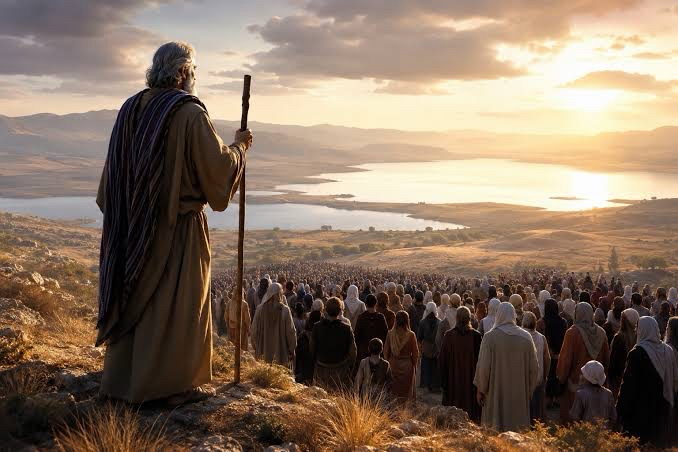
Moses, the greatest leader our people have ever known, stands on the eastern bank of the Jordan. He can see the land. He can almost breathe it. He has carried a difficult people through slavery, panic, rebellion, hunger, thirst, war, and forty years of complaints—some justified, some less so, because even in the wilderness everyone apparently had an opinion and, I suspect, a committee prepared to express it. Yet after all of this, Moses will not enter.
“Va’etchanan el Adonai”—“I pleaded with G-d.” The man who confronted Pharaoh, split the sea, ascended Sinai, and spoke with G-d pleads for one personal wish. The answer is no.
There is a loneliness in that moment every serious leader understands. Leadership does not spare us disappointment or promise that we will finish what we began. Sometimes it means bringing others to a shore we ourselves will never cross.
And yet Moses does not spend his final days nursing grievance. He teaches. He reminds. He warns. He gives Israel the Ten Commandments again. He gives us the Shema. He tells us to love G-d with heart, soul, and might. He tells parents to teach their children. He insists that a nation’s greatness is not measured only by the enemies it defeats, the territory it holds, or the strength of its army, but by the justice of its laws and the moral discipline of its people.
That may be the most demanding lesson of all: power can win a battle, but only character can preserve a nation.
A Brief Synopsis of Va’etchanan
――――― ◆ ❧ ◆ ―――――
Parashat Va’etchanan—Deuteronomy 3:23–7:11—opens with one of Torah’s most human moments. Moses pleads to cross the Jordan after forty years of carrying Israel toward it. G-d says no. Moses may climb the mountain and see the land, but Joshua will lead the people into it. In a few aching verses, Torah gives us disappointment, succession, mortality, and the truth that even the greatest leader does not own the future.
Moses then turns from private sorrow to public duty. He urges Israel to guard the covenant and build a society so just that other nations will call it “wise and discerning.” He also warns that prosperity can be more dangerous than hardship. In the wilderness, dependence upon G-d was obvious—manna to gather, water to seek, a cloud to follow. In the land of homes and harvests, the people may begin to worship the work of their own hands. Memory, here, is not nostalgia. It is the guardrail keeping freedom from sliding into arrogance.
Take utmost care and watch yourselves scrupulously, so that you do not forget the things that you saw.” —Deuteronomy 4:9
The portion establishes cities of refuge, insisting that justice distinguish murder from tragedy and vengeance from due process. Moses then restates the Ten Commandments for a new generation. Their movement is telling: from our bond with G-d to the obligations that hold human society together—honor, life, marriage, property, truth, and the discipline of desire. Freedom without moral restraint, Moses knows, soon becomes another kind of slavery.
At the center stands the Shema: “Hear, O Israel, Adonai is our G-d, Adonai is One.” Moses continues: “You shall love Adonai your G-d with all your heart and with all your soul and with all your might.” Then comes the obligation that makes faith an inheritance: “Impress them upon your children.” Before Israel speaks, it must listen. Before it commands, it must hear. Faith is not meant to remain comfortably seated in the sanctuary; it must walk with us into ordinary life.
This is also Shabbat Nachamu, the Sabbath of Comfort. Isaiah calls, “Comfort, comfort My people.” Coming after Tisha B’Av, the placement matters. Judaism does not ask us to forget the ruins. It asks us not to live forever inside them—to turn memory into wisdom, suffering into responsibility, and comfort into the courage to begin again.
The Leader Who Could Not Cross
――――― ◆ ❧ ◆ ―――――
Moses’ greatness is revealed not merely in what he achieved, but in how he faced what he could not achieve. He pleaded, but he did not confuse prayer with entitlement. He protested, but he did not burn down the covenant because the answer wounded him. He prepared Joshua, strengthened the people, and transformed personal disappointment into public instruction.
Rabbi Jonathan Sacks called this a politics of covenant: not power descending from above, but responsibility shared below.
A leader’s first duty is not to be admired, but to see clearly; not to survive politically, but to serve faithfully; and to know that the future does not belong to him, even when he helped make it possible.
Moses does something else modern leaders often find nearly impossible: he acknowledges a limit. Today, limits are treated as weakness. Every microphone invites certainty. Every camera rewards defiance. Every political consultant seems convinced that humility polls badly. But Torah teaches that a leader without limits is not strong; he is dangerous. Pharaoh had unlimited power and no moral restraint. Moses had unmatched authority and still knew how to kneel.
The Idea That Traveled from Sinai to America
――――― ◆ ❧ ◆ ―――――
Moses tells Israel that if it lives by laws rooted in justice, other nations will look upon it and say, “Surely this great nation is a wise and discerning people.” He imagines something revolutionary: a nation admired not merely for wealth, weapons, or empire, but for the righteousness of its laws.
What great nation is there that has laws and rules as perfect as all this Teaching that I set before you this day?
—Deuteronomy 4:8
That idea crossed oceans.
The Hebrew Bible gave the West prophets who challenged kings, midwives who defied an immoral command, and a covenant placing even the sovereign beneath the law. Its language crossed the Atlantic with the Puritans and entered the American experiment. John Adams wrote that the Hebrews had done more to civilize humanity than any other nation. The cadences of American public life remain unmistakably biblical.
American Presidents of both parties have drawn upon that inheritance. Reagan spoke of “one people under G-d.” George H. W. Bush prayed that power be used only to serve. Clinton invoked a promised land; George W. Bush the image of the Creator; Obama the duty to carry freedom to “our children’s children.” American speechwriters have been borrowing from Moses for generations; so far, the Torah has been gracious enough not to send a royalty statement. Yet these were more than graceful phrases. They were American midrash on Devarim—covenant, journey, testing, inheritance, and liberty entrusted to the next generation.
But biblical language becomes hollow if it is used only to decorate speeches. The covenant is not a stage prop. A president who invokes Moses must also hear Moses: power has boundaries; law matters; human life is sacred; memory is a national duty; and leadership is answerable to a Judge higher than history’s applause.
What This Means for Israel
――――― ◆ ❧ ◆ ―――――
Israel faces threats that are real, immediate, and not theoretical. Iran’s rulers have armed proxies, launched attacks, and built a regional strategy around Israel’s exhaustion and isolation. No responsible Israeli leader can ignore that danger. The first obligation of a government is to protect its people, and Jewish history has taught us—at unbearable cost—what happens when threats against Jews are dismissed as rhetoric.
Yet Va’etchanan asks Israel to remember that survival is the beginning of responsibility, not its end. Military strength may be essential, but it cannot become the whole language of the nation. Moses did not say the nations would admire Israel because its chariots were faster. He said they would admire the justice of its laws.
That places a severe burden on Israel’s leaders: defend the country without allowing fear to become its permanent constitution; confront Iran’s threat while distinguishing a regime from the millions beneath it; care for soldiers and grieving families, bring hostages home, strengthen border communities, and preserve democratic institutions even in wartime.
Recent openings with Lebanon, made possible in part by the weakening of Iran’s regional axis, hint at another obligation of leadership: to recognize a door when history cracks it open. Victory is not complete when an enemy is weakened. It becomes meaningful when strength creates a safer political future.
Israel also needs the internal language of covenant. Secular and religious, right and left, veteran and newcomer, Jew and Arab citizen may disagree fiercely; Israel would hardly be Israel if they did not. But disagreement cannot become mutual excommunication. A nation cannot stand forever if each camp believes it alone owns patriotism, suffering, morality, or G-d.
Moses’ message to Israel is therefore both steel and tenderness: be strong enough to defend the covenant, and humble enough to remain worthy of it.
What This Means for the United States
――――― ◆ ❧ ◆ ―――――
America now finds itself in a painful argument over war, presidential power, congressional authority, national security, and the cost paid by young men and women in uniform. This week’s divided votes in the House and Senate are more than procedural drama. They reveal a nation struggling to decide where lawful authority begins, where it ends, and how responsibility is shared when American lives are placed in danger.
That is precisely the kind of argument the Constitution was designed to force us to have. The American system does not assume that leaders are angels. It divides power because biblical wisdom and human experience agree on one point: concentrated power eventually begins to mistake itself for providence.
The President bears a burden no commentator fully carries. Intelligence is incomplete. Time is short. Allies are vulnerable. A decision delayed can cost lives; one rushed can cost generations. We should distrust the easy confidence of those who never see the briefing, write the letter to a grieving parent, or stand at Dover when the fallen return home.
But the loneliness of command does not erase accountability. Moses spoke with G-d and still answered for his actions. An American President commands immense power and still answers to the Constitution and the people. Courage must act; discipline must explain: What is the objective? What protects the innocent? What ends the war?
The same questions apply to Congress. It is easy to denounce presidential overreach and harder to accept constitutional responsibility for war and peace. Legislators cannot demand authority and then avoid ownership. Covenant is not a spectator sport.
America’s challenge is not simply to prevail over Iran’s aggression. It is to do so without becoming unrecognizable to itself. The test of a republic is whether it can remain lawful when frightened, humane when angry, united when divided, and humble when powerful.
What This Means for Iran
――――― ◆ ❧ ◆ ―――――
Va’etchanan also compels us to speak carefully about Iran. The Iranian regime is not the Iranian people. A government that exports terror, suppresses dissent, and places ideological ambition above the welfare of its citizens has betrayed the first moral purpose of leadership.
The Iranian people inherit one of the world’s great civilizations. They are not abstractions on a targeting map, but parents, students, merchants, physicians, poets, believers, skeptics, and children who would rather grow up than become symbols in someone else’s war. We can oppose the regime without losing sight of their humanity.
Moses warns that power without covenant decays into idolatry—and the most dangerous idol is the state worshipping itself. Iran’s leaders must choose between preserving a revolutionary system and serving a living nation. A ruler who sacrifices his people to preserve an ideology has reversed the moral order.
True courage in Tehran would not be another missile launch. It would be choosing the future over grievance, the welfare of citizens over proxy armies, and honest negotiation over theatrical defiance. The bravest act of leadership is sometimes to stop.
What This Means for Ocean Reef
――――― ◆ ❧ ◆ ―――――
Ocean Reef is not Washington, Jerusalem, or Tehran—and for this we may all be grateful. Our disagreements are unlikely to close the Strait of Hormuz. Still, the moral architecture of leadership does not change merely because the scale is smaller.
We are stewards of institutions, congregations, boards, neighborhoods, friendships, and a community whose beauty can sometimes make us forget how much patient work sustains it. Decisions about buildings, infrastructure, security, philanthropy, worship, communication, and the use of shared resources may not enter history books, but they enter people’s lives.
Moses reminds us that leadership in community requires listening before announcing, explaining before demanding, and remembering that every spreadsheet contains human consequences. It also requires patience with meetings—those remarkable gatherings where minutes are carefully kept and hours occasionally misplaced. It means resisting the temptation to turn disagreement into disloyalty, protecting minority voices while still making decisions, and understanding that civility is the discipline allowing neighbors to remain neighbors after the vote.
We also inherit Moses’ obligation to prepare those who come after us. The measure of leadership is not how indispensable we become, but whether the community remains strong when we step aside. Joshua’s success was not Moses’ defeat. It was Moses’ final achievement.
At Ocean Reef, covenant may sound like too grand a word for committee rooms and community meetings. Yet covenant simply means that we belong to one another beyond convenience. It asks us to place the common good above the momentary victory, to speak truth without humiliation, and to leave this remarkable community not merely more valuable, but more generous, more faithful, and more whole.
Final Reflection — The View from the Mountain
――――― ◆ ❧ ◆ ―――――
At the end of Va’etchanan, Moses remains outside the land. There is no last-minute reversal, no political miracle, no triumphant exception for a beloved leader. He sees the future, blesses it, and lets it go.
Perhaps that is why his words still live.
Had Moses made the final chapter about himself, it would have ended at the Jordan. Instead, he made it about covenant, and so it entered every generation. He teaches us that leadership is not possession. A country is not the property of its president. A people is not the property of its prime minister. A movement is not the property of its founder. A congregation is not the property of its chairman. We are temporary guardians of permanent obligations.
The world this week is loud with aircraft, votes, warnings, speeches, and grief. Va’etchanan asks us to listen beneath the noise for a quieter voice: Shema Yisrael—Hear, O Israel. Hear before you answer. Remember before you act. Love before you command. Teach before you depart.
The great nations are not those that never face danger. They are those that refuse to let danger decide who they become.
Moses could not cross the river. But his words did. They crossed into Israel, into Jewish memory, into the conscience of America, and into every room where a leader must choose between ego and duty, force and restraint, applause and truth.
That is the promised land still before us.
A Prayer for Wisdom, Courage, and Peace
――――― ◆ ❧ ◆ ―――――
May the One who grants wisdom to the humble guide the leaders of the United States, Israel, Iran, and all nations. Give them courage without cruelty, strength without arrogance, and restraint without fear. Protect those who defend the innocent. Comfort the bereaved, heal the wounded, return the captives, and shelter every child who trembles beneath the sound of war. Help us distinguish between a people and its rulers, between justice and vengeance, and between victory that ends a battle and peace that saves a generation. May we become wise enough to hear, brave enough to change, and faithful enough to choose life. And may the day come when nation shall not lift up sword against nation, neither shall they learn war anymore. Amen.
Shabbat Shalom
Michael L Weiss Ph.D. HCCP
Support Our Congregation
Please consider supporting our congregation so we may continue offering meaningful programs and community events. Your generous gift helps make this work possible.
Donate Now