
PARSHAT COMMENTARY · SUKKOT 5787
When Strong Walls Are Not the Answer
Friday, September 25, 2026 — 14 Tishrei 5787
Shabbat, September 26, 2026 | First Day of Sukkot — 15 Tishrei 5787
Leviticus 22:26–23:44
Parshat Commentary By Michael L. Weiss, PH.D., HCCP
In April of 2025, I made what seemed like a fairly simple commitment: I would write a weekly Parshat commentary for what was becoming our Congregation Ocean Reef newsletter.
I had no idea what I was getting myself into.
At first, the commentaries were straightforward retellings of the weekly Torah portion, grounded in traditional and historical understanding. Slowly, they began to change. I started asking what these ancient words meant not only to our ancestors, but to us—to our congregation, our country, and Israel.
From there, the journey deepened. I began looking at the words handed down to Moses thousands of years ago and asking how they might help us understand the world we are living in today: division, leadership, antisemitism, community, responsibility, and our continuing obligation to repair what is broken.
What I thought would require a couple of hours each week somehow became fifteen or twenty hours of reading, studying, researching, reflecting, writing, rewriting—and occasionally staring at a blank screen wondering how Moses managed without spellcheck.
But what an extraordinary journey it has been.
I have learned far more than I ever expected. My understanding of our faith has deepened enormously, as has my appreciation for Judaism and for the ways so many other faith traditions grew from foundations first established in ours. Week after week, I have discovered something new in words I thought I already understood.
And for that, I owe all of you a great deal of gratitude.
You gave me a reason to undertake this journey and an audience willing to read these sometimes not-so-short reflections. I hope that somewhere along the way, some of these thoughts have been helpful in your own lives—or at least provided something worthwhile to consider over your morning coffee.
Now we begin a new year.
For the past several months, I have been looking back at what I wrote the year before and asking how I could keep these messages fresh and meaningful rather than simply repeating familiar lessons in different words.
This week, however, I am about to begin a different kind of journey.
After a long summer filled with personal matters and other commitments, Cheryl—my wife, my partner, and my bashert—and I are taking some time away. We will be traveling through Sicily and Italy, joining members of the Ocean Reef Yacht Club for part of the trip before eventually making our way back to the Reef.
As you might imagine, devoting fifteen or twenty hours each week of our vacation to writing these commentaries would be an extraordinary disservice to my wife—and potentially hazardous to my marital harmony.
So, for the next three or four weeks, I am going to take a brief pause from my weekly Torah commentary.
I will not, however, stop writing altogether.
Some of you know that when Cheryl and I travel, I publish a travel journal called Besorah, an ancient Hebrew word meaning “good news.” It is part travel journal, part Jewish history lesson, and part guide for anyone who may one day follow the same path. I try to explore not only where we go, but Jewish life in the places we visit—the history, communities, synagogues, and stories that often remain just beneath the surface.
This trip is especially meaningful. We are celebrating our time together and my official entry into my seventh decade of life—something that, given some of the places my earlier career and work took me, I once genuinely wondered whether I would ever reach.
That fact alone gives me plenty to be grateful for.
If you would like to follow along, we will include a link in the newsletter, or you can find the journal at Besorah.org.
When we return, we will be heading directly back to Ocean Reef and into what promises to be a busy, enlightening, exciting, and spiritually meaningful season for our congregation.
Before we begin it, I simply want to say thank you.
Thank you for allowing me to learn alongside you, for indulging my occasional long-windedness, and for taking the time each week to read these commentaries. I hope that now and then, something within them has spoken to your own life.
So please enjoy this first message of our new year.
◆ ◆ ◆
And perhaps it is fitting that this brief pause comes with Sukkot.
Because there is something wonderfully Jewish about Sukkot.
We spend most of our lives trying to make things more secure. We build stronger homes, accumulate savings, buy insurance, install generators, upgrade seawalls, replace roofs, strengthen electrical grids, and—at Ocean Reef—occasionally spend what feels like the gross domestic product of a small nation making sure everything survives the next hurricane.
And then along comes the Torah and says: Wonderful. Now go outside and live in a hut.
Not a particularly sturdy hut, either.
The roof must allow us to see something of the sky. The walls need not withstand a hurricane. There is no requirement for impact glass, reinforced concrete, or, thankfully, approval from an architectural review committee.
For seven days, Judaism deliberately moves us from permanence into impermanence.
That may be one of the most important lessons we can hear right now.
We live in a world obsessed with certainty. We want certainty about politics, Israel, the economy, our health, and our future—and, judging from social media, absolute certainty about subjects we first learned about eleven minutes ago.
Sukkot quietly reminds us that certainty was never really ours.
What we have instead is faith.
Community.
Gratitude.
And the responsibility to use whatever time and blessings we have been given to make this world a little better than we found it.
After the solemnity of Rosh Hashanah and Yom Kippur, Sukkot does something remarkable. Judaism does not leave us standing at the gates of repentance.
It tells us to start living again.
And to do so with joy.
A Synopsis of the Torah Reading
――――― ◆ ❧ ◆ ―――――
Because this Shabbat is also the first day of Sukkot, we step away from the regular weekly Torah cycle and read a special festival portion from Leviticus.
The reading moves into one of the Torah’s great calendars of sacred time:
Shabbat.
Passover.
Shavuot.
Rosh Hashanah.
Yom Kippur.
And finally, Sukkot.
The Torah tells us:
“On the fifteenth day of this seventh month shall be the Feast of Booths for seven days unto the Lord.”
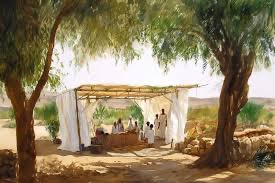
We are instructed to rejoice, gather the fruit of the land, take the traditional species associated with the festival, and dwell in sukkot so that future generations will remember that the Children of Israel lived in temporary shelters when G-d brought them out of Egypt.
But the Torah does not simply tell us to remember the wilderness.
It asks us to recreate something of its vulnerability.
We leave the house.
We enter the sukkah.
We sit beneath branches through which the heavens remain visible.
For one week, the wealthy and the poor, the powerful and the powerless, the secure and the uncertain sit beneath essentially the same fragile roof.
It is difficult to become too impressed with ourselves while eating dinner in a structure that can be seriously inconvenienced by a stiff breeze.
Perhaps that is part of the point.
The Paradox of Sukkot
――――― ◆ ❧ ◆ ―――――
Sukkot is called Z’man Simchateinu—the season of our rejoicing.
Think about that.
The Torah does not command us to rejoice inside a fortress.
It commands us to rejoice inside a temporary booth.
We normally imagine happiness arriving when everything is settled: the problem is solved, the war is over, the children are safe, the diagnosis is good, the election is finished, and every troublesome item has finally been checked off.
In other words, sometime around the year 2147.
Sukkot offers another possibility.
Joy cannot depend upon the complete absence of uncertainty because human life has never offered such a bargain.
Our ancestors wandered through the wilderness without knowing what tomorrow would bring. Yet we remember not only their vulnerability, but the divine protection that accompanied them.
The sukkah therefore represents two things at once:
fragility and security.
Its walls are fragile.
Its message is not.
Strength is not always measured by the thickness of our walls. Sometimes it is measured by the strength of our relationships, the character of our communities, the depth of our faith, and our willingness to stand beside one another when the winds begin to blow.
What This Means for All of Us
――――― ◆ ❧ ◆ ―――――
Sukkot speaks with remarkable clarity to Israel, to America, and to our own community at Ocean Reef because each, in very different ways, wrestles with the same question: where does real security come from?
For Israel, security must include the ability to defend Jewish life, but the Torah reminds us that strength is never only military. Justice, human dignity, moral leadership, memory, faith, and the ability to rebuild are also forms of strength. Power without righteousness eventually becomes fragile.
For the United States, the lesson is equally timely. We live in an age when disagreement too often becomes contempt and political identity can overwhelm common purpose. Sukkot reminds us that no leader, party, or movement possesses the whole truth. Institutions matter, limits on power matter, and a society survives only when people can disagree without destroying one another.
And here at Ocean Reef, the lesson comes closer to home. We are blessed with beautiful surroundings and considerable resources, but Sukkot reminds us that none of these are permanent. We are custodians for a time. What endures is the community we build—the friendships, traditions, institutions, acts of kindness, and willingness to show up for one another when the skies change.
Israel, America, and Ocean Reef are obviously very different places, but the lesson is the same:
strong walls matter, but strong people and strong communities matter more.
The sukkah teaches us that what ultimately protects us is not permanence, because permanence is an illusion. What protects us is character, faith, responsibility, and the knowledge that when the wind begins to blow, we will not be standing alone.
Four Species, One People
――――― ◆ ❧ ◆ ―――――
Sukkot also gives us one of Judaism’s most visual lessons: the four species gathered together.
Our sages saw in them different kinds of people—those possessing learning, those possessing good deeds, those possessing both, and those perhaps still working on the assignment.
Only when they are brought together can the mitzvah be fulfilled.
There is wisdom in that.
We do not repair the world by eliminating everyone who disagrees with us.
We repair it by learning how different people can remain part of one community.
That does not require abandoning principles.
It requires something harder:
Hold your convictions.
And still recognize the humanity of the person standing beside you.
The lulav might be considerably easier to manage if it consisted of one perfectly uniform branch.
But that is not the mitzvah.
And thankfully, that is not humanity.
A Closing Reflection — Look Through the Roof
――――― ◆ ❧ ◆ ―――――
Perhaps the most beautiful feature of the sukkah is that its roof is deliberately incomplete.
We are supposed to be able to look through it toward heaven.
What an extraordinary architectural instruction.
For most of the year, we build roofs to keep the outside out.
For Sukkot, we build one that reminds us to look beyond ourselves.
Maybe that is exactly what we need after the intensity of the High Holy Days.
Rosh Hashanah asks us to consider who we are.
Yom Kippur asks us to acknowledge where we have failed.
And Sukkot asks:
Now that you have thought about all of that, how are you going to live?
Not someday, now.
Will we be more patient?
Will we call the friend we have neglected?
Will we listen before responding?
Will we defend those targeted by hatred?
Will we speak truth when lies become fashionable?
Will we strengthen our community rather than merely criticize it?
Will we recognize our blessings while we still have the opportunity to enjoy them?
Sukkot reminds us that life itself is a temporary dwelling.
We enter.
We stay awhile.
Eventually another generation takes our place.
We cannot determine how long we will remain in the sukkah.
But we can determine what kind of guests we will be while we are here.
So this week, perhaps we should worry a little less about whether the walls are perfectly straight.
Sit beneath the branches.
Look through the openings.
See the stars.
Invite someone in.
Share a meal.
Tell a story.
Laugh a little.
Give thanks.
And remember that the miracle of life is not that everything is permanent.
It is that despite knowing nothing is permanent, we are still commanded to rejoice.
That may be one of Judaism’s greatest acts of faith.
And one of its greatest gifts.
A Prayer for Sukkot
――――― ◆ ❧ ◆ ―――――
May the One who sheltered our ancestors in the wilderness shelter us and all who seek peace.
May G-d protect the people of Israel, strengthen those who defend the innocent, comfort those who mourn, heal those who suffer, and guide leaders toward wisdom, justice, and restraint.
May our nation rediscover the ability to disagree without hatred, to debate without contempt, and to remember that our common humanity is greater than our political differences.
May our Ocean Reef community remain a place of friendship, generosity, faith, and service—a community in which we care for one another and welcome one another beneath a common roof.
May we have the courage to recognize what is temporary, the wisdom to protect what is eternal, and the gratitude to rejoice in the blessings already before us.
And as we sit beneath the fragile covering of the sukkah, may we remember that our greatest security has never been found in walls alone, but in faith, family, community, and the presence of G-d.
Chag Sukkot Sameach.
May this festival be filled with joy, peace, gratitude—and, hopefully, cooperative weather.
And if any of you feel especially inspired by the spirit of the holiday and would care to volunteer to write a section on one of the upcoming Parshiot while I am away, I would consider that not only a mitzvah, but a very personal blessing.
Dr. Michael L. Weiss, Ph.D., HCCP
President, Congregation Ocean Reef
Support Our Congregation
Please consider supporting our congregation so we may continue offering meaningful programs and community events. Your generous gift helps make this work possible.
Donate Now
Wonderful newsletter. Hope you and your bashert (had to look that up) have a wonderful time in Italy and Sicily.