
Parshat : Sh’mini
April 3, 2026 | 16th of Nisan, 5786
Torah Reading: Leviticus 9:1–11:47
Commentary by Michael L. Weiss, PhD, HCCP
President, Congregation Ocean Reef
Opening Reflection
There are weeks when the Torah feels comforting, and there are weeks when it feels as though it has read the headlines before we did.
This is one of those weeks.
We are living through a season in which fire is everywhere. There is literal fire in the Middle East as the war involving Iran, Israel, and the United States continues to widen, touching multiple fronts and rattling energy markets, diplomacy, and the confidence of ordinary people trying to make sense of tomorrow.
But we must be morally serious enough to keep proportion. A painful rise in energy prices is real. Families feel it. Businesses feel it. We all feel it. Yet we cannot confuse a temporary, even if deeply unpleasant, increase in the cost of gasoline with the far greater cost of failing to contain a nuclear-armed Iran. That cost would not be measured merely at the pump. It would be measured in blackmail, terror, regional intimidation, global instability, and the emboldening of a regime whose revolutionary ideology is openly hostile to the West, to democratic institutions, and to the moral inheritance of biblical faith. Temporary economic pain, however unwelcome, is still temporary. The price of allowing such a regime to cross the nuclear threshold would be paid for years, perhaps generations, in fear, coercion, and the slow corrosion of ordered liberty. That is the scale on which serious people must think. And even within the present shock, analysts expect easing later in 2026 when supply recovers and emergency reserves help stabilize markets.
And as if the calendar itself wished to offer us a theological hint, this year Passover and Easter arrive within the same sacred stretch of days. That overlap is not a curiosity. It is a reminder. Jews and Christians are, in very real ways, standing on adjoining ground this week — both traditions turning again toward memory, redemption, sacrifice, deliverance, covenant, suffering, hope, and the stubborn insistence that G-d is still at work in history.
That is precisely why Sh’mini matters.
Because Sh’mini is not some polite little parsha tucked away for scholars with elbow patches, tidy libraries, and entirely too much affection for footnotes. It is a parsha about what happens when holiness and human passion collide. It is a parsha about sacred ambition, unrestrained impulse, leadership, grief, boundaries, and the dangerous temptation to confuse sincerity with righteousness.
In recent weeks, we have spoken about lessons that keep building on one another: blessings are not trophies, holiness is not performance, and sacred responsibility requires discipline no less than feeling. We saw that in Ki Tisa, when passion without restraint became catastrophe. We saw it in Vayakhel-Pekudei, when the people’s generosity only became holy once it was ordered toward a higher purpose. We saw it again in Tzav, where sacred service depended not on drama, but on constancy. This week the Torah sharpens that lesson with unnerving clarity: not every fire is holy simply because someone lit it in G-d’s name.
That is not only a biblical lesson. It is a lesson for nations. It is a lesson for movements. It is a lesson for institutions. And, if we are honest, it is a lesson for each of us, because most of us at one point or another have offered our own version of “strange fire” — a word spoken too quickly, certainty worn too proudly, ego dressed up as conviction, or zeal mistaken for wisdom.
The Torah reminds us that there is a difference between warmth and combustion. Frankly, in 2026, that distinction would be useful in Washington, Tehran, on college campuses, on cable news, on social media, and yes, now and then, even in synagogue board meetings. In some corners of modern life, we have confused passion with permission and volume with virtue. The Torah, as usual, is less impressed.
The Shape and Meaning of the Parsha
Parshat Sh’mini begins on the eighth day of the consecration of the Mishkan, when Aaron at last steps fully into his priestly role and the glory of G-d appears before all the people. It should be a moment of triumph — the culmination of all the preparation, sacrifice, waiting, and hope. The sanctuary is complete, the people are gathered, and holiness seems ready to settle gently into the camp. That long buildup is exactly what makes the rupture so jarring, this is the climax of the longest sacred prelude in the Torah, only to be shattered at the very moment of fulfillment.
And then, almost without warning, the Torah turns.
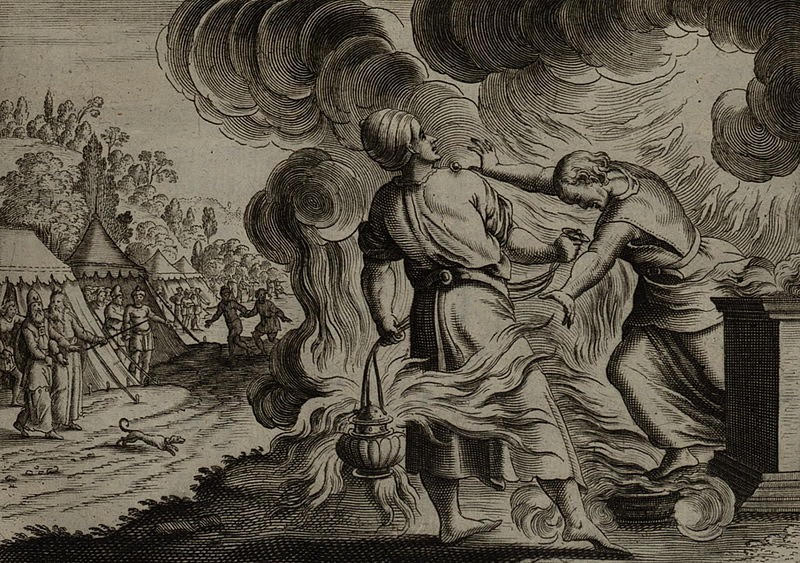
Nadav and Avihu, the sons of Aaron, bring what the Torah calls esh zarah — strange fire, unauthorized fire, fire “which He had not commanded them.” Fire comes forth from before the Lord and consumes them. Celebration becomes tragedy in an instant. Aaron, their father, falls silent. What should have been the crowning moment of sacred order becomes one of the most shocking and painful scenes in the Torah. The issue is not merely technical error, Nadav and Avihu took the energies proper to humanity’s encounter with the world and applied them to humanity’s encounter with the Divine. In another arena, such initiative might have made them heroic. In holy space, it became a contradiction.
But Sh’mini does not end there, and that matters.
The Torah moves immediately from the deaths of Nadav and Avihu into an odd and easily overlooked dispute over the chatat offering — whether it should have been eaten by the priests or burned entirely. On the surface it sounds technical, almost dry. It is anything but. Beneath that legal exchange lies a profoundly human question: what can a grieving soul bear in the wake of catastrophe? Aaron is not only the High Priest in this moment. He is also a father who has just lost two sons.
And then, just when we think the parsha has said enough, it turns again — this time to the laws of kashrut, the distinctions between the pure and the impure, what may be eaten and what may not, what belongs inside and what must remain outside. That movement is not random. It is the Torah’s way of telling us that holiness depends upon discernment. Not everything belongs everywhere. Not every urge deserves expression. Not every passion is permission.
That is not repression.
That is civilization.
So Sh’mini begins with glory, passes through grief, and ends with discernment. It is a parsha about sacred service, human loss, dangerous impulse, and the discipline required to make space for G-d. Or, put more bluntly, it is the Torah’s warning that even in holy places, a loose wire is still a loose wire.
What This Means in Light of This Week
This week’s events make Sh’mini feel less ancient and more diagnostic.
We are watching political, military, and religious cultures all struggle with the difference between conviction and sanctimony, between courage and recklessness, between justice and ego. The war with Iran has widened into a broader regional confrontation, while rising energy costs, threatened shipping lanes, and economic uncertainty are being felt far beyond the battlefield.)
Meanwhile, here at home, millions of Americans are carrying their own fear and fury into the streets, protesting not only policy but a growing sense that too many leaders now perform moral seriousness rather than embody it.
That is what makes Nadav and Avihu so contemporary. They are not frightening because they are obviously wicked. They are frightening because they are insiders. Priests. Participants in sacred work. Men close to the center.
And that is the warning.
The greatest dangers to sacred communities often do not come from outside attack alone. They come when those inside the tent decide that passion exempts them from discipline, that sincerity can replace commandment, or that being emotionally moved is the same thing as being morally right.
Judaism has never taught that intensity by itself is virtue. Quite the opposite. It teaches that fire must be tended, bounded, elevated, and disciplined, or else it destroys the very house it was meant to warm. As our sacred text say, with terrific force, religion is fire: it warms, but it also burns, and we are the guardians of the flame.
That line belongs on the wall of every parliament, newsroom, university, clergy office, and family dining room in the Western world.
And because Passover and Easter are meeting one another on the calendar this year, that lesson feels even more urgent. Both traditions know that redemption is never cheap. Both insist that holiness is not improvisation for its own sake. Both stand on foundations laid by memory, sacrifice, obedience, and covenantal responsibility. When faith forgets its foundations, it does not become freer. It becomes thinner, louder, and far more impressed with itself than Heaven is likely to be.
Reform and Conservative Insights
One of the things I treasure about Jewish learning is that our different movements often circle the same truth from different directions.
Reform voices often read Sh’mini through the tension between innovation and overreach: Jewish life must be renewed, yes, but renewal severed from covenant, wisdom, and responsibility can become destructive rather than redemptive. Conservative commentary, especially from Jewish Theological Seminary, tends to stress leadership, restraint, humility, communication, and the discipline required in sacred service.
I find both of those readings deeply useful.
Because yes, we need innovation. Any Judaism that cannot speak to modern life risks becoming a museum exhibit with better lighting and, if we are lucky, decent kugel. But innovation without humility is not renewal. It is improvisation with a lit match near the curtains.
And as every synagogue veteran knows, once someone starts improvising with fire, the rest of us end up on a committee. Usually a subcommittee. Occasionally with coffee cake.
What This Means for Israel
Israel, perhaps more than any nation on earth, understands what it means to live with both literal fire and moral fire at the same time.
This week again underscored that Israel is not confronting isolated threats but a networked, ideological, and militarized ecosystem of hostility.
For Israel, Sh’mini is a reminder that survival requires both strength and sanctity. A Jewish state must defend Jewish life with clarity and resolve. But it must also remember the difference between power that is accountable and power that becomes intoxicated with itself. That is true in war. It is true in governance. It is true in speech.
Israel’s strength is not only that it can wield fire. Its strength, at its best, is that it remembers fire is not G-d.
Civilization depends on remembering that distinction.
And in this unusual week, when Jews sit in Passover and Christians move toward Easter, there is also a deeper civilizational truth worth naming. The roots of Western moral life did not emerge from nowhere. They were shaped by biblical memory, covenant, conscience, law, sacrifice, liberation, and a view of history in which G-d asks something of us. Israel remains central to that story — not only strategically, which it surely is, but spiritually and historically as well.
What This Means for the United States
America is also standing in the smoke of competing fires.
We are witnessing polarization so intense that almost every event is immediately baptized as absolute good or absolute evil, depending on one’s tribe. That is not moral seriousness. That is emotional idolatry with Wi-Fi.
The lesson of Sh’mini for America is not that passion is bad. Heaven forbid. Democracies need passion. They need protest, argument, dissent, conviction, organizing, and public conscience. But not every passionate act is righteous simply because it is passionately performed. When a nation loses the ability to distinguish between principled action and unauthorized fire, between courage and narcissism, institutions begin to burn from the inside.
Freedom without restraint becomes chaos. Religion without humility becomes fanaticism. Politics without moral boundaries becomes spectacle.
We do not need less passion in America.
We need better-governed passion.
And perhaps, this week especially, America needs memory. Passover teaches that freedom is a gift but never self-sustaining. Easter teaches millions of Christians that suffering and hope are not opposites. Both traditions push against amnesia. Both tell us that faith has roots. A country cut off from moral memory is like a spark in dry brush: dramatic for a moment, destructive for much longer.
What This Means for Our Community at Ocean Reef
This parsha also speaks directly to us.
At Ocean Reef, we are building something precious. We have worked hard to create not merely programs, not merely events, and certainly not merely attractive evenings with good hors d’oeuvres — though let us be honest, in our community the hors d’oeuvres do matter — but a real spiritual home.
And here at Ocean Reef, this week gave us a beautiful reminder of what sacred community can look like at its best. We just celebrated the largest Passover Seder in the history of Congregation Ocean Reef. That alone is worth pausing to reflect upon. Not merely because the room was full, though it was. Not merely because the evening was joyous, elegant, and warmly shared, though it certainly was. It is worth pausing because Passover asks us to do something rare: to stop, to remember, and to place ourselves within a sacred story larger than our individual lives.
At the Seder, we do not simply recount the bondage of our ancestors. We renew our understanding that freedom is fragile, gratitude is a discipline, and identity must be passed from one generation to the next with care and conviction. What made this year’s gathering especially moving was that many who joined us were our Christian friends — present not only as a beautiful sign of unity within our Ocean Reef community, but out of a sincere desire to deepen their understanding of the shared roots and faith traditions that connect us. In that, there was something profoundly hopeful.
To witness that gathering was to be reminded that people still hunger for meaning. They still seek belonging. And they still respond when the invitation is not merely social, but sacred. For one evening, around those tables, we did more than observe a ritual meal. We bore witness to the sacred work of remembrance, to the costly gift of freedom, to the grace of friendship, and to the hopeful truth that faith need not be a force of division, but can instead be a light by which we come to understand one another more fully.
And whenever something sacred is being built, the temptation is always the same: to substitute momentum for meaning, personality for principle, or excitement for holiness.
That is why this parsha is such a gift.
It reminds us that being close to sacred work is not the same as owning it. None of us owns the flame. We are custodians of it. Leaders, clergy, volunteers, donors, board members, congregants — all of us are servants of something greater than ourselves.
That means our task is not merely to be enthusiastic.
It is to be worthy.
If we have learned anything this year, it is that holiness in a community is built not only through inspiration but through discipline, patience, reverence, and the willingness to put the mission above ego. That has been one of our recurring lessons, and it is worth repeating now: sacred community is strongest when it is less interested in who gets credit and more interested in whether G-d’s presence can genuinely dwell among us.
That was true in the Mishkan. It is true in a synagogue. It is true in a chapel shared by many traditions. And it is true in every act of interfaith bridge-building we attempt.
Personal and Final Reflection
There is something especially haunting about Aaron’s silence after the death of his sons.
Not every tragedy can be explained in real time. Not every pain should be met with a speech. Not every wound benefits from instant commentary — and in an age where everyone feels obliged to post, pronounce, denounce, and package their feelings before breakfast, that itself is a lesson worth taking seriously.
Sometimes the holiest response is restraint.
After Nadav and Avihu die, the Torah does not simply leave Aaron in silence and move on. It gives us that strange exchange over the chatat offering, where Aaron, in effect, says: look what has happened to me — would this really be what G-d asks of me today? In that moment, Aaron the High Priest gives way to Aaron the father. And Moses hears him. And the Torah tells us it was acceptable in his eyes. That is not weakness. That is truth. And truth, when spoken without pretense, is often one of the holiest things we have.
Nadav and Avihu wanted to go closer. In some sense, that longing was beautiful. But longing without obedience became destruction. Aaron teaches a different lesson. He teaches that sometimes the most sacred act is not to reach upward in ecstasy, but simply to stand honestly within sorrow, before G-d, without performance.
So this week, as the world feels overheated, let us remember: not every fire is from Heaven.
Some fires illuminate. Some consume. Wisdom is knowing the difference.
And this year, as Passover and Easter arrive side by side, may we take that not as a novelty, but as a summons — to remember the foundations of faith, to honor memory, to cherish freedom, to respect sacrifice, and to build lives worthy of the truths we claim to inherit.
May we be a people who know how to warm a cold world without burning it down.
May we seek holiness without ego, courage without recklessness, and faith without fanaticism.
And may the Holy One help us guard the flame.
Prayer for Peace
Ribbono Shel Olam, Master of the Universe,
grant peace to Israel, strength to the defenders of freedom,
wisdom to the leaders of nations,
comfort to those who mourn,
healing to those who are wounded,
and courage to all who stand against hatred and chaos.
Teach us to choose holy fire over strange fire,
humility over arrogance,
service over self,
and life over destruction.
May G-d bless the United States of America.
May G-d protect Israel.
And may G-d watch over all His children.
Oseh shalom bimromav,
Hu ya’aseh shalom aleinu, v’al kol Yisrael, v’al kol yoshvei tevel.
May the One who makes peace in the heavens
bring peace to us, to all Israel, and to all the world.
Amen.
Shabbat Shalom,
Dr. Michael L. Weiss, Ph.D., HCCP
President, Congregation Ocean Reef
Support Our Congregation
Please consider supporting our congregation so we may continue offering meaningful programs and community events. Your generous gift helps make this work possible.
Donate Now