
Parshat : Tzav
Shabbat, March 28, 2026 | 9 Nisan 5786
Torah Reading: Leviticus 6:1–8:36
Commentary by Michael L. Weiss, Ph.D., HCCP
Opening Reflection
Welcome to Parshat Tzav.
A parsha whose central theme, quite inconveniently for modern sensibilities, is that some things are not optional.
Tzav means command.
Not recommendation.
Not best practice.
Not “circle back after pickleball.”
Command.
And that is what makes this parsha so timely.
We are living in an age that prefers feelings to obligations, slogans to sacrifice, and moral posturing to moral seriousness. Everyone has an opinion. Everyone has a grievance. Everyone would like justice, provided it is inexpensive, emotionally satisfying, and does not interfere with gasoline prices.
That, of course, is not how the real world works.
This week’s headlines remind us of that. The war involving the United States, Israel, and Iran has continued to rattle markets and energy supplies. Oil prices surged on fears of escalation before dropping sharply after President Trump announced a five-day delay in planned strikes on Iranian energy infrastructure amid reported talks.
Let me say this plainly: if the cost of confronting a radical regime bent on nuclear capability and regional terror is a temporary spike at the pump, that is not the collapse of civilization. That is called paying a price for living in the adult world.
Liberty has a cost.
Justice has a cost.
Security has a cost.
And Torah has never once suggested otherwise.
And that is why this parsha speaks so powerfully right now. The war with Iran was not negligence. It was not recklessness. It was not some optional foreign-policy hobby that got out of hand between cable news segments. It was necessity born of reality. A regime that has spent decades funding terror, destabilizing the region, threatening Israel, menacing American interests, and pursuing nuclear capacity was never going to be talked into becoming Switzerland.
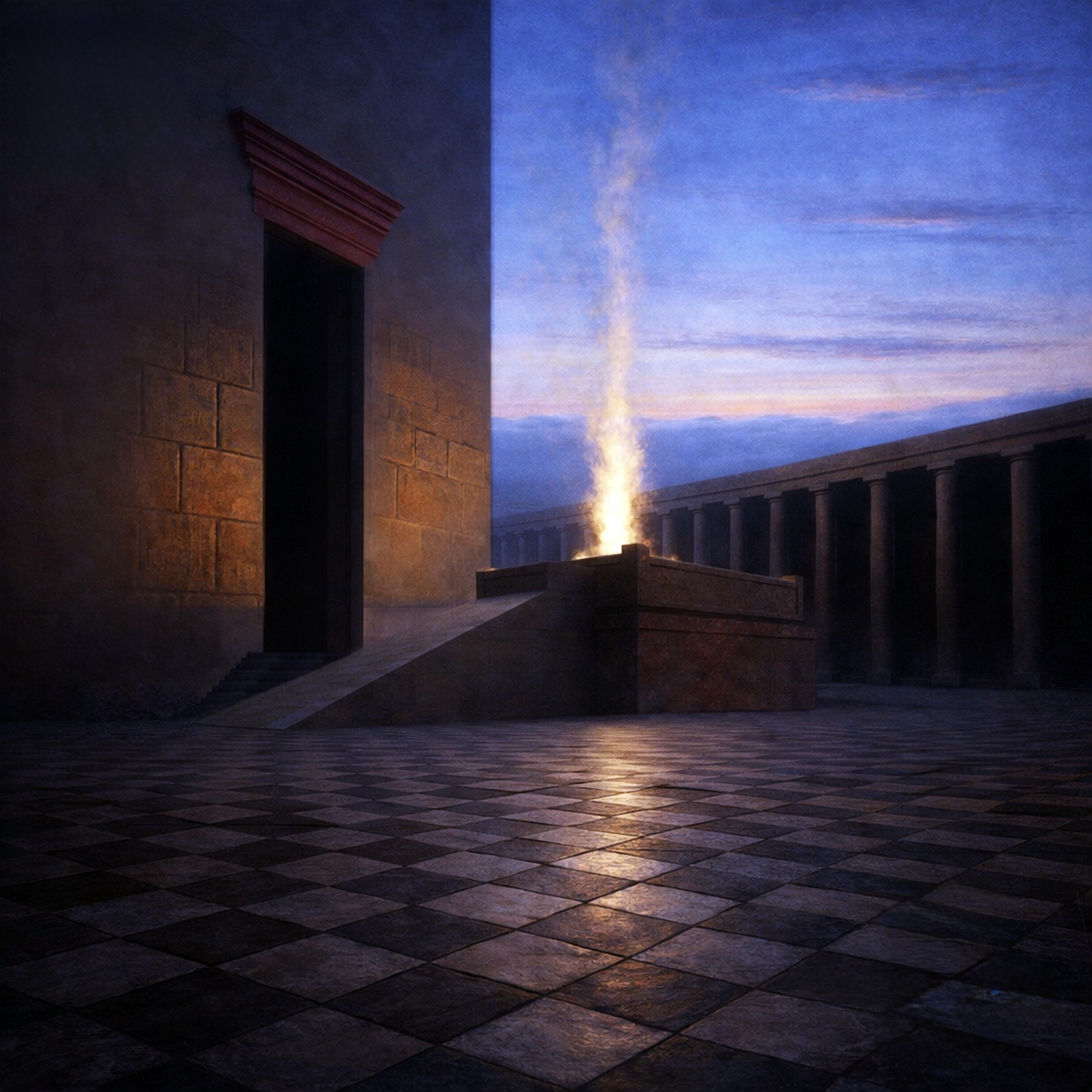
And that is precisely why Parshat Tzav is such a fitting Torah reading for this moment. Tzav is a parsha about commandment, duty, discipline, and sacrifice. It reminds us that the preservation of what is holy always costs something. The altar does not tend itself. The fire does not keep burning by accident. The priest does not serve when convenient. He serves because he is commanded. He rises, he prepares, he sacrifices, he clears the ashes, and he returns to do it again. In other words, Tzav is not about religious feeling. It is about the moral burden of responsibility.
That is the bridge to where we are now.
We are living in a world where too many people want security without sacrifice, justice without cost, and peace without the unpleasant business of confronting evil. Tzav will have none of that. It teaches that sacred order is maintained only when people are willing to bear obligation, accept discomfort, and act decisively in service of something larger than themselves. That is true in the sanctuary. It is true in communal life. And, whether we like it or not, it is true in the life of nations.
So when we open Parshat Tzav in a week like this, we are not escaping the modern world for some dusty ancient ritual manual. We are confronting one of Torah’s enduring truths: that liberty, justice, and holiness are not sustained by slogans or good intentions. They are sustained by commandment, courage, and sacrifice. At some point, duty matters more than debate. And that is exactly what makes Tzav not only relevant, but uncannily current.
The Shape of the Parsha
Parshat Tzav continues the priestly instructions that began in Vayikra. We read about the burnt offering, meal offering, sin offering, guilt offering, and offerings of well-being. We are told that the fire on the altar must be kept burning continuously. Then the portion turns to the ordination of Aaron and his sons, the formal setting apart of sacred leadership for service. Reform summaries of the portion likewise emphasize the sacrificial system and the consecration of Aaron and his sons.
But as always, if we stop at the mechanics, we miss the point.
Tzav is really about what a civilization does with human fire.
Because human beings are going to burn with something: anger, fear, ambition, grief, desire, tribal loyalty, pride. Torah does not deny that. It disciplines it. It redirects it. It places boundaries around it. It insists that power, passion, and even pain must answer to something higher.
That is one of the great insights of Judaism. We do not become holy by pretending human beings are tame. We become holy by refusing to let instinct run the sanctuary.
Both Reform and Conservative Judaism, in different ways, help illuminate that point. Reform thinkers often emphasize that korban is not merely “sacrifice” in the crude sense, but drawing near to G-d, a movement of relationship and moral closeness. Conservative voices often stress that Jewish holiness lives in disciplined action, in commanded practice, not just in lofty ideals. Together they remind us that Judaism is not merely what we feel. It is what we do, repeatedly, faithfully, and sometimes when we would rather be doing something else. Which, if we are honest, is the story of most meaningful things in life.
What This Means for Israel
For Israel, Tzav is a warning and a comfort at the same time.
The warning is this: even necessary force must remain morally governed. The Torah does not celebrate fire because it is fire. It gives it a place, a boundary, and a purpose. Even the altar has rules.
That matters.
Israel does not have the luxury of naïveté. It lives in a neighborhood where genocidal rhetoric is not performance art. It is strategic intent. Iran’s regime has spent decades building, funding, and directing a regional architecture of terror while pushing toward greater nuclear capability and threatening both Israel and U.S. interests. The present conflict has disrupted regional shipping, driven oil shocks, and drawn in direct U.S. military considerations.
So no, this war was not born of negligence. It was born of letting reality finally have a vote.
And yet Tzav also gives comfort, because it reminds Israel that discipline is not weakness. Restraint is not surrender. Moral seriousness is not confusion. The Jewish task is not to enjoy force. It is to use force, when necessary, in defense of life, and then remain human afterward.
That is harder than slogans.
It is also holier.
What This Means for the United States
America should pay close attention to Tzav because we have become a nation that enjoys moral vocabulary more than moral burden.
We love justice in theory. We become less enthusiastic when justice has an invoice.
We want evil contained, but preferably by someone else, somewhere else, at no cost to ourselves, with no market reaction, no strategic risk, and no increase in what it costs to fill up the Range Rover before dinner.
Again: that is not how history works.
If Iran had been allowed to move further down the path toward a nuclear weapons capability while continuing to sponsor terror and threaten its neighbors, the eventual cost would almost certainly have been far higher than a temporary energy shock. Markets have already shown how central the Strait of Hormuz is to global stability, with oil spiking above $112 a barrel before falling back below $100 after the announced pause in strikes. U.S. gasoline prices also rose amid fears of wider conflict.
That is unpleasant. It is not catastrophic.
A nuclear-armed radical Islamic regime would be catastrophic.
There is a difference.
And here Tzav offers a profound lesson. Sacrifice in Torah is not meaningless loss. It is purposeful offering in service of something higher. Personal sacrifice for liberty, justice, and the protection of civilization is not a tragic accident of history. It is, in the deepest sense, sacred. The Torah’s commandments are built on that premise: that duty to something greater than oneself is not oppression. It is the foundation of moral life.
The United States ultimately had to act because the threat was no longer theoretical. At some point, delay becomes its own form of irresponsibility. At some point, failing to confront evil is not prudence. It is surrender dressed up as sophistication.
And Washington, like Jerusalem, should know better.
What This Means for Our Community at Ocean Reef
At Ocean Reef, Tzav asks a wonderfully inconvenient question:
What exactly are we willing to sacrifice for what we say we value?
Not in the dramatic Hollywood sense. No one is asking you to rappel into Natanz between lunch and cocktails.
But in the real sense.
Are we willing to sacrifice a little comfort for principle?
A little time for service?
A little ego for community?
A little convenience for faith?
Because that is where Jewish life actually happens.
Tzav reminds us that sacred community is not built by grand declarations. It is built by people who keep the fire going. People who show up. People who prepare. People who carry responsibility when no one is clapping. People who clean up the ashes and come back the next morning to do it again.
That, by the way, is also an excellent description of every successful congregation.
Judaism is not sustained by occasional inspiration and attractive stationery. It is sustained by commanded acts, repeated loyally, by people who understand that holiness requires maintenance. Reform Judaism speaks beautifully about drawing near. Conservative Judaism speaks powerfully about disciplined mitzvah. Our task is to do both: to build a community with heart and backbone, warmth and seriousness, humor and reverence.
Preferably all before Kiddush.
Final Reflection
Parshat Tzav is not a gentle little essay about spirituality. It is a working manual for moral civilization.
It tells us that some fires must never go out: faith, courage, duty, memory.
And it tells us that those fires do not sustain themselves.
They must be fed.
They must be guarded.
They must be directed.
And yes, sometimes they require sacrifice.
That is true in the sanctuary.
It is true in family.
It is true in community.
And it is certainly true in the world of nations.
So let us stop pretending every act of force is a moral failure. Sometimes force is the final bill presented after years of denial. Sometimes war is not chosen because leaders are careless, but because the alternatives have been exhausted by people who mistake wishful thinking for wisdom.
This war with Iran was not an act of negligence. It was necessity.
That does not make it pretty.
It does not make it painless.
It does not make it free.
But it does make it understandable.
And Torah, in its unsentimental wisdom, would recognize that immediately. Tzav does not teach us that sacred life is easy. It teaches us that sacred life costs something. It asks us whether we are prepared to bear that cost in service of what is right.
That is the real question before all of us.
Not whether sacrifice is unpleasant. Of course it is.
Not whether discipline is burdensome. It usually is.
Not whether duty is glamorous. It rarely is.
The question is whether what stands on the other side is worth it.
For Israel, yes.
For America, yes.
For the defeat of a radical regime seeking the tools of nuclear terror, absolutely yes.
A few weeks of expensive gasoline is irritating.
A world intimidated by a nuclear Iran is intolerable.
Torah knows the difference. We should too.
Closing Prayer
Ribbono Shel Olam, Master of the Universe,
keep alive within us the fire of courage, discipline, and moral clarity.
Protect the people of Israel, the United States, and all those who stand against terror and tyranny.
Strengthen those who bear burdens in defense of liberty and justice.
Guard our community, our families, and all who labor in quiet faithfulness.
Teach us that sacrifice in the service of what is holy is never wasted.
Teach us that duty is sacred.
Teach us that commandment is not a burden to resent, but a calling to honor.
May the fire on our altar never go out.
And may we be worthy of tending it.
Oseh shalom bimromav, Hu ya’aseh shalom aleinu, v’al kol Yisrael, v’al kol yoshvei tevel.
May the One who makes peace in the heavens bring peace to us, to all Israel, and to all the world.
Shabbat Shalom,
Dr. Michael L. Weiss, Ph.D., HCCP
President, Congregation Ocean Reef
Support Our Congregation
Please consider supporting our congregation so we may continue offering meaningful programs and community events. Your generous gift helps make this work possible.
Donate Now