
PARASHAT CHUKAT
Numbers 19:1–22:1
When Leaders Strike the Rock
Friday, June 19, 2026 / 4 Tammuz 5786
Commentary by Michael L. Weiss, Ph.D., HCCP
A note before we begin: this week’s commentary is longer than usual. I make no apology for that, though I do offer my usual sympathy to those who were hoping for a quick read with their second cup of coffee. The world we now find ourselves living in does not lend itself to short paragraphs or easy conclusions. War, diplomacy, grief, leadership, mortality, and faith are all pressing upon us at once.
And while this weekend is Father’s Day, we cannot allow the moment to pass without remembering that this week’s Torah portion commemorates the passing of Miriam — one of the most powerful, courageous, and important women in the biblical story. Without Miriam, there may have been no Moses as we know him, no Exodus as we inherited it, and no song at the sea to teach us how a redeemed people begins to sing. So this week, even as we honor fathers, we also pause to celebrate Miriam: prophetess, sister, guardian, leader, and wellspring of courage for the Jewish people.
When Leaders Strike the Rock
There are weeks when history does not move forward so much as it presses down upon us. This has been such a week. We watch Israel, America, and Iran locked in a dangerous struggle where every decision carries the weight of lives not yet lost, cities not yet struck, and mistakes not yet made. The language of diplomacy has now entered the battlefield through a difficult and awkward fourteen-point memorandum of understanding signed by the President. It may be necessary. It may be wise. It may be the beginning of restraint. It may also be one of those documents that offers the comfort of words while leaving the deeper wound untouched. For the Jewish people, this is not an academic question. We have learned that the distance between promise and protection can be measured in blood.
And Israel, as so often in Jewish history, is asked to listen carefully not only to what is written, but to what is missing. The Jewish people have learned, sometimes at unbearable cost, that silence in an agreement can speak as loudly as any clause. We know what it means when others negotiate over threats that are aimed at us. We know what it means to be told, “Do not worry, there will be verification,” while the very people who threaten our existence treat time itself as a weapon.
So how does Torah see this moment?
Not as a partisan matter. Torah is not a cable news panel, thank G-d. Moses did not descend from Sinai and say, “I have breaking analysis after this commercial break.” Torah looks deeper. It asks: What happens when leaders are exhausted? What happens when nations are grieving? What happens when anger replaces wisdom? What happens when we mistake a temporary document for a lasting covenant? And what happens when human beings, entrusted with power, forget that they are neither gods nor insects, but something far more complicated and sacred?
This week’s parsha, Chukat, enters precisely there and is one of the strangest and most emotionally powerful portions in the Torah.
It begins with the ritual of the red heifer, a law so mysterious that even our sages treated it as beyond full human understanding. A perfectly red cow is burned, reduced to ash, and those ashes are mixed with living water to purify those who have come into contact with death. Life becomes ash. Ash is mixed with water. From death comes purification. From loss comes the possibility of return.
Then, almost without warning, the Torah tells us that Miriam dies. Just one sentence. No grand eulogy. No long obituary. No “Celebration of Life” with a luncheon to follow, though knowing our people, there would have been kugel somewhere in the wilderness.
“There Miriam died and was buried.”
And immediately after that, the people have no water.
The rabbis saw the connection. In Miriam’s merit, they taught, a miraculous well accompanied the Israelites through the desert. When Miriam died, the water stopped. But Rabbi Sacks, of blessed memory, reminds us that there is another and perhaps even deeper connection. Moses did not simply lose access to water. Moses lost his sister.
Miriam was not a supporting character in Moses’ life. She was the reason Moses survived infancy. She followed the basket in the Nile. She approached Pharaoh’s daughter. She arranged for Yocheved, Moses’ own mother, to nurse him. She preserved his identity before he even knew he had one. She was the first quiet architect of Jewish survival.
And now she was gone.
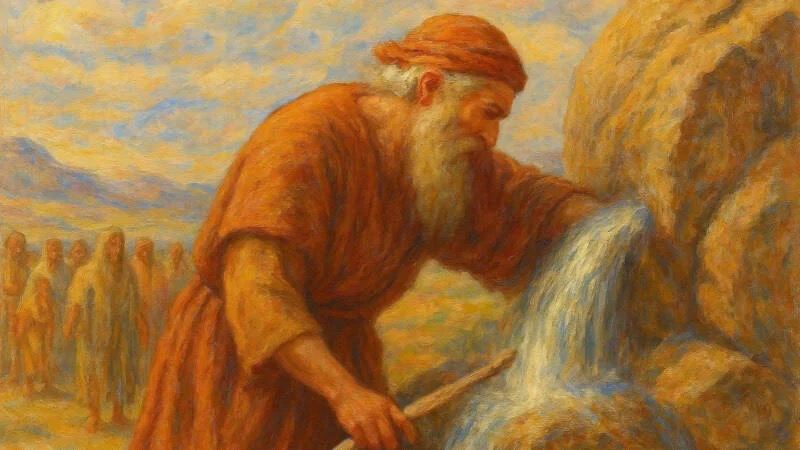
So when the people complain yet again — “Why did you bring us into this wilderness? Why is there no water?” — Moses, the greatest prophet in Jewish history, loses his temper. G-d tells him to speak to the rock. Moses strikes it. Not once, but twice. Water comes forth, but the moment has already changed history. Moses and Aaron are told they will not enter the Promised Land.
We have read this story many times, and every year we ask the same question: Was the punishment too harsh? After all, Moses had carried this people for forty years. He had endured rebellion, fear, ingratitude, golden calves, spies, complaints about food, complaints about water, complaints about leadership, and probably complaints about the seating chart at Sinai. One mistake, and he loses the dream?
But perhaps Torah is teaching something more subtle and more human. Moses is not punished because he is evil. Moses is not rejected because he failed. Moses is shown to be mortal because even the greatest leader cannot lead forever, and even the strongest soul can be wounded by grief.
This is the great humility of Judaism. We do not turn our leaders into gods. Moses is the greatest prophet, but he is still Moses. He can be tired. He can be heartbroken. He can misunderstand the moment. He can strike when he was commanded to speak.
That is a lesson our world desperately needs.
We live in an age where leaders are either idolized or destroyed. We either expect them to be messiahs or we treat them as fools. Torah rejects both. The President who signs a fourteen-point memorandum is not a savior because he signs it, nor a traitor because we fear it. Israeli leaders who must respond to it are not warmongers because they are cautious, nor naïve because they hope diplomacy might buy time. Military commanders, diplomats, intelligence officers, and elected officials are all operating in the wilderness, where every rock looks like it might produce water and every wrong strike can echo for generations.
Chukat teaches that the hardest task of leadership is not simply knowing when to act. It is knowing when to speak, when to strike, when to wait, and when to admit that one is carrying grief into the decision.
A Brief Synopsis of Chukat
Parashat Chukat opens with the mysterious law of the red heifer, the ritual used to purify those who have come into contact with death. It then turns to the death of Miriam, followed immediately by the people’s complaint that there is no water. Moses and Aaron seek G-d’s guidance. G-d instructs Moses to speak to the rock, but Moses, overcome with frustration, strikes the rock instead. Water emerges, but Moses and Aaron are told they will not enter the Promised Land.
The parsha then records the death of Aaron, the transition of the priesthood to his son Eleazar, the people’s continued struggles in the wilderness, the episode of the fiery serpents, and the beginning of Israel’s military confrontations as they move closer to the land.
In one portion, we encounter death, purification, leadership failure, transition, war, healing, and the long march toward a future that some will help create but never live to see.
That, too, feels familiar.
The Red Heifer and the Strange Consolation of Mortality
The red heifer is one of those mitzvot that reminds us we are not as smart as we think we are. That alone makes it a useful commandment.
We live in a time when everyone has an instant opinion, usually typed with great confidence and minimal punctuation. The Torah, however, begins Chukat with mystery. It says: before you speak about death, war, leadership, and national destiny, remember that not everything can be mastered by human reason.
Chukat is about mortality. Miriam dies. Aaron dies. Moses is told he will die before entering the land. Yet the parsha begins with purification, as if G-d creates the remedy before the wound. The red heifer is reduced to ash, but the ash is mixed with living water. Human beings return to dust, but within us is the breath of G-d. We are small, but not insignificant. We are mortal, but not meaningless.
This is where Torah speaks directly to our world.
The war with Iran, the danger to Israel, the American role, the difficult memorandum, the debate over what was gained and what was conceded — all of it reminds us that we are living in the tension between dust and destiny. Nations can act with power, but they must do so with humility. Leaders can sign documents, but they must know that paper does not purify hatred. Armies can destroy facilities, but they cannot alone create peace. Diplomacy can pause a war, but it cannot transform a regime’s soul unless truth is joined to verification and hope is joined to vigilance.
The Torah is not against agreements. Judaism is built on covenant. But Torah knows the difference between a covenant and a memorandum. A covenant requires moral transformation. A memorandum may simply mean that two parties have agreed to stop bleeding for the moment.
Moses, Miriam, and the Pain Beneath the Anger
The great insight of this parsha is that anger often hides grief.
Moses appears angry at the people, but beneath that anger is loss. His sister is gone. The woman who watched over him before he could watch over himself is no longer there. The well dries up because Miriam’s presence had been a hidden source of life all along.
How often this happens in our own lives. A family loses a matriarch, and only then realizes she was the one holding everyone together. A community loses a quiet leader, and suddenly the things that once seemed automatic become difficult. A nation loses moral clarity, and then wonders why its institutions feel thirsty.
Miriam represents the kind of leadership that rarely gets enough credit while it is alive. She does not thunder from Sinai. She does not confront Pharaoh with plagues. She does not carry the tablets. But without Miriam, there may be no Moses. Without her courage, there may be no Exodus. Without her song, there may be no music after the sea.
In our world, we often honor the person holding the microphone and forget the person who made sure the lights were turned on, the chairs were set, the children were safe, and the future had a chance. In Ocean Reef terms, we know exactly who those people are. They are the ones who do not need a title, because they are too busy doing the work.
Miriam teaches us that some of the most important water in life comes from people who never ask to be called a well.
What This Means for Israel
For Israel, Chukat is a warning and a comfort.
The warning is that grief can distort judgment. Israel has been living with grief since October 7th — grief for the murdered, grief for the hostages, grief for soldiers, grief for families shattered, grief for innocence lost, grief for a world that too often asks Israel to explain why it prefers survival to sympathy.
A nation in grief must still make decisions. That is the burden of Jewish sovereignty. Israel does not have the luxury of being merely a moral symbol. It must defend borders, rescue hostages, deter enemies, maintain alliances, and sometimes absorb the discomfort of decisions made by friends who do not live within missile range.
The memorandum with Iran may bring temporary relief. It may open maritime routes, pause escalation, and create space for negotiation. But Israel must ask the Chukat question: are we speaking to the rock, or are we striking it? Are others speaking words of peace while leaving intact the machinery of future war? Are we being asked to accept water now while ignoring the poison upstream?
The comfort is that Torah understands Israel’s loneliness. Moses, after Miriam dies, stands before a thirsty people and a silent rock. He is surrounded, yet alone. Israel knows that feeling. Surrounded by advice, resolutions, condemnations, allies, critics, and experts who have never had to put their children in safe rooms, Israel must still decide how to live.
Chukat tells Israel: do not become what your enemies accuse you of being. Do not let grief turn into rage without discipline. Do not let strength become arrogance. But also do not surrender moral clarity to the comforting language of those who confuse quiet with peace.
The Jewish people are commanded to choose life. Sometimes choosing life means compromise. Sometimes it means restraint. Sometimes it means fighting. The wisdom is knowing which moment we are in.
What This Means for the United States
For the United States, Chukat offers a lesson in humility.
America remains powerful, but power is not prophecy. We should be cautious whenever any administration, of any party, declares that a complex Middle Eastern arrangement has solved the problem. The Middle East has a long history of humbling those who arrive with maps, talking points, and confidence. It is the one region in the world where even the sand seems to have a memory.
The Torah would ask America not only, “What are the fourteen points?” but “What is the moral point?”
Does the agreement protect life? Does it restrain evil? Does it reduce the likelihood of war without financing the next one? Does it strengthen allies or leave them guessing? Does it distinguish between a regime and its people? Does it recognize that peace without accountability can become merely a ceasefire with better stationery?
America’s greatness has never been simply its power. It has been its willingness, at its best, to align power with moral purpose. That is not always easy. It is certainly not always neat. But Torah reminds us that leadership without humility becomes dangerous, and humility without courage becomes weakness.
The red heifer teaches that purification requires contact with ashes and living water. America must be honest about both — the ashes of war and the living water of possible peace. We should pray that our leaders have the wisdom to know the difference between a necessary pause and a dangerous illusion.
What This Means for Ocean Reef
For our Ocean Reef community, Chukat may feel far away from our daily lives, but it is not.
We may not be negotiating with Iran over fourteen points, although some of our committee meetings can feel almost as long and nearly as delicate. We are, however, always negotiating the balance between memory and future, grief and hope, leadership and humility, self-interest and community.
Miriam’s death reminds us to honor the people who sustain the community quietly. Every congregation, every chapel, every foundation, every neighborhood, every committee has its Miriams. They make the calls. They notice who is missing. They bring food. They remember names. They smooth tensions. They keep the water flowing.
Often, we do not fully appreciate them until the well runs dry.
Chukat also reminds us that leadership in community requires emotional discipline. When people are anxious, they complain. When people are afraid, they demand certainty. When costs rise, plans change, storms threaten, or the future feels unclear, we can all become Israelites in the wilderness asking, “Why did you bring us here?”
The leader’s task is not to strike the rock every time the crowd gets loud. It is to listen, to speak, to seek G-d’s guidance, and to remember that the person across the table may also be carrying grief we cannot see.
Ocean Reef is at its best when we act not merely as residents or members, but as a covenantal community. That means we do not measure every issue only by “What does this cost me?” or “How does this affect my street?” but by “What kind of community are we building together?”
A club is maintained by dues. A community is maintained by covenant.
Speaking to the Rock
The central image of Chukat is simple and devastating. G-d tells Moses to speak. Moses strikes.
That may be the most relevant sentence of the week.
In a world of missiles, drones, sanctions, naval blockades, press conferences, and memoranda of understanding, Torah asks whether we still know how to speak. Not perform. Not threaten. Not posture. Speak.
Speak truthfully. Speak humbly. Speak with moral clarity. Speak knowing that words can bring water, but only when they are joined to faith and discipline.
There are times when striking is necessary. Judaism is not naïve about evil. The Torah knows Pharaoh. It knows Amalek. It knows that some enemies cannot be persuaded by poetry. But Chukat reminds us that even when force has been necessary, the goal must be a return to speech, to covenant, to life.
Moses’ tragedy is not that he failed completely. He did not. Water came from the rock. The people lived. But the way he brought water mattered. In Torah, means and ends are never fully separated. How we act shapes who we become.
That is true for nations. It is true for Israel. It is true for America. It is true for Ocean Reef. And, painful as it is to admit, it is true for each of us.
Closing Reflection
Chukat is a parsha about death, but it is not depressing. It is about mortality, but it is not hopeless. It is about leaders who fail, but it is not cynical. It is about grief, but it still gives us water.
That is the genius of Torah.
We are dust and ashes, but we carry the breath of G-d. We make mistakes, but we can still do holy work. We will not enter every promised land we help prepare, but that does not make the journey meaningless. Moses does not cross the Jordan, but without Moses there is no people ready to cross. Miriam dies, but her song still echoes. Aaron dies, but the priestly blessing still rests upon our children.
This week, as the world watches leaders sign documents, armies stand alert, Israel measures risk, America debates strategy, and ordinary families simply pray for their children to be safe, Chukat reminds us to hold two truths at once.
We must be humble because we are mortal.
We must be courageous because we are partners with G-d.
May our leaders learn when to speak and when to act. May Israel be protected with strength, wisdom, and moral clarity. May America use its power with humility and purpose. May our community honor the Miriams among us before the wells run dry. And may G-d bring living water to a thirsty world.
________________________________________________________
Oseh shalom bimromav, Hu ya’aseh shalom aleinu, v’al kol Yisrael, v’al kol yoshvei tevel.
May the One who makes peace in the heavens bring peace upon us, upon all Israel, and upon all who dwell on earth.
Shabbat Shalom.
Support Our Congregation
Please consider supporting our congregation so we may continue offering meaningful programs and community events. Your generous gift helps make this work possible.
Donate Now