
P A R A S H A T R E’ E H
The Courage to See: Choosing Blessing in a World of Consequences
――――― ◆ ❧ ◆ ―――――
Deuteronomy 11:26–16:17
August 7, 2026 ◆ Shabbat, August 8, 2026
Commentary by Michael L. Weiss, Ph.D., HCCP
――――― ◆ ❧ ◆ ―――――
There are weeks when the news feels less like history unfolding and more like Groundhog Day with missiles.
The same threats. The same warnings. The same leaders gathering around different tables to discuss the same dangers. The world remains uncomfortably close to the brink, and each morning’s headlines seem to arrive wearing yesterday’s clothes.
Yet beneath the noise, something else is also happening.
Diplomats are still talking. Nations that once stood far apart are discovering shared interests. Israel continues to defend itself while building, creating, and celebrating life. America remains resolute in protecting our troops and allies while searching for a path that does not require another generation to learn the cost of war firsthand. Even within Iran, millions of ordinary people still hope for freedom, opportunity, and a future no longer defined by the ambitions of their rulers.
That is not naïveté. It is perspective.
History is filled with moments when the world appeared trapped in a cycle it could not escape—until courage, wisdom, or simple human decency interrupted the pattern. Darkness can be persistent, but it is not creative. It repeats itself. Hope, on the other hand, keeps finding new doors.
Into this uncertain but still hopeful hour comes Parshat Re’eh and one of the most arresting words in the Torah: Re’eh—See.
Moses does not begin with “obey,” “march,” “fight,” or even “believe.” He begins by asking the people to open their eyes:
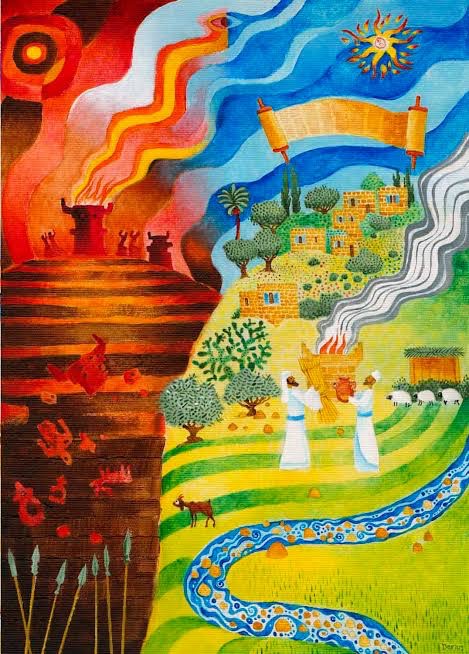
“See, I set before you today a blessing and a curse.”
—Deuteronomy 11:26
The word today matters. Moses was speaking more than 3,000 years ago, but the choice he described did not expire in the wilderness. Every generation is given its own version of blessing and curse. Every nation must decide whether it will be governed by principle or appetite, responsibility or expediency, truth or whatever happens to be trending before breakfast.
That is why this week’s parsha is so relevant to our lives today. We live in a world overflowing with information but often starving for wisdom. We can see events unfolding in real time on our televisions and phones, yet still fail to recognize where they are leading.
The Torah asks more of us than simply watching. It asks us to understand.
Before a nation can choose well, it must see clearly. It must see not only the danger before it, but the possibility beyond it; not only the enemy across the border, but the humanity living behind that border; not only what power can destroy, but what courage, wisdom, and faith can build.
That is the burden—and the privilege—of leadership. A leader must see farther than the next headline, deeper than the next poll, and more honestly than the next speech.
Re’eh reminds us that blessing and curse rarely arrive wearing name tags. They usually begin as choices—small enough to overlook, yet powerful enough to change the direction of a nation.
The world may still be standing near the brink. But the Torah insists that we are not condemned to remain there. The blessing is still before us, the choice is still ours, and tomorrow does not have to be another version of yesterday.
A Brief Synopsis of Re’eh
――――― ◆ ❧ ◆ ―――――
Parashat Re’eh, Deuteronomy 11:26–16:17, opens with one of the Torah’s clearest and most consequential declarations:
“See, I set before you today a blessing and a curse.”
—Deuteronomy 11:26
Moses is preparing the Israelites to enter the Promised Land without him. They are about to exchange the simplicity of the wilderness for the complexity of nationhood. In the desert, G-d provided manna, water, direction, and protection. Once they enter the land, they will build homes, establish cities, cultivate farms, accumulate wealth, and exercise political power.
The miracles will become less obvious, and the choices more difficult.
Moses warns that Israel’s future will not be determined by geography, military strength, natural resources, or prosperity alone. It will depend upon the moral choices the people make once they possess those things.
Blessing and curse are not merely rewards and punishments dropped randomly from heaven. They are consequences built into human decisions. A society that honors life, restrains power, protects the vulnerable, and remains faithful to its values creates the conditions for blessing. A society that worships power, exploits the weak, and forgets the source of its freedom eventually creates its own curse.
Moses commands Israel to reject idolatry. To modern ears, idolatry may sound like an ancient concern involving statues and unfamiliar rituals. But an idol is anything we create and then allow to control us.
Power can become an idol. Wealth can become an idol. Political ideology, military strength, technology, popularity, and even nationalism can become idols when they are placed beyond moral criticism. The danger is not only that we bow before carved images, but that we begin worshipping the work of our own hands and mistaking success for righteousness.
Re’eh also establishes a central place of worship, reminding Israel that national unity requires shared purpose. The tribes may live in different regions and possess different interests, but they must not become separate nations occupying the same land.
The lesson remains relevant. A nation can survive disagreement; it cannot survive the complete loss of shared meaning. We need not think alike, vote alike, or worship alike. But we must retain some common understanding of truth, justice, responsibility, and the dignity of human life.
The parsha then addresses permitted foods, debt relief during the sabbatical year, the freeing of Hebrew servants, care for the poor, and the celebration of Passover, Shavuot, and Sukkot.
At first glance, it seems to move from worship to diet, from debt relief to festivals—a Torah itinerary with more stops than an airport shuttle. Yet these commandments form one vision: holiness must enter ordinary life.
The Torah does not confine faith to a sanctuary. Faith must shape what we consume, how we conduct business, how we treat employees, how we respond to poverty, how we use wealth, and how we celebrate our blessings.
The dietary laws teach discipline. Not everything we desire must be consumed simply because it is available.
The release of debts teaches that an economy must serve human beings rather than permanently imprison them.
The laws concerning servants teach that freedom must include the means to begin again. When a servant is released, the Torah commands that he not be sent away empty-handed. Otherwise, release is little more than abandonment with better public relations.
The laws of tzedakah teach that poverty is not someone else’s problem:
“Do not harden your heart or shut your hand against your needy brother. Rather, you shall open your hand to him.”
—Deuteronomy 15:7–8
The festivals also carry a social message. Passover, Shavuot, and Sukkot are not to be celebrated selfishly. The Torah includes children, servants, strangers, widows, orphans, and those without land of their own. Joy is incomplete when it excludes the lonely or forgotten.
That is the deeper meaning of Re’eh. Moses is not simply giving Israel a collection of religious rules. He is describing the moral architecture of a free society.
Freedom must be joined to responsibility. Prosperity must be joined to generosity. Power must be limited by law. Worship must lead to ethical behavior. National strength must protect human dignity. Joy must be shared.
The choices described in Re’eh are personal, but their consequences are collective. Every generation stands again between blessing and curse, deciding what kind of people it will become.
The blessing is placed before us. But we must still choose it.
The Politics of Seeing
――――― ◆ ❧ ◆ ―――――
Moses offers no easy promise that good choices will produce easy days. He knows better. He spent forty years leading people who could turn a miracle into a complaint before lunch.
But he teaches that difficult circumstances do not release us from responsibility. Even under pressure, a nation remains morally accountable for what it chooses.
That may be one of the most important lessons for our leaders today.
War does not eliminate morality. Fear does not suspend judgment. Popularity does not transform a poor decision into a wise one. A crisis may narrow our options, but it does not remove our obligation to choose responsibly.
The Jewish vision of leadership is therefore very different from the world’s familiar worship of power. The Torah does not ask whether a ruler can dominate the room. It asks whether the ruler can govern himself.
It does not ask whether a leader can silence criticism. It asks whether that leader can hear truth.
It does not ask whether a leader can win every argument. Sometimes leadership consists of preventing the argument from becoming a funeral.
Moral life begins in wonder and ends in responsibility. Re’eh joins the two: first see, then act.
The lesson for today is that strength and peace are not necessarily opposites. Properly understood, strength should protect peace, and diplomacy should give strength a moral purpose. Leaders fail when they treat force as the only answer, but they also fail when they pretend that words alone will restrain those who respect only consequences.
Wisdom is knowing which moment requires which response.
The Open Hand
――――― ◆ ❧ ◆ ―――――
Re’eh then turns from affairs of state to the human being at the gate:
“Do not harden your heart or shut your hand against your needy brother. Rather, you shall open your hand to him.”
—Deuteronomy 15:7–8
Notice the order: first the heart, then the hand.
Closed hands usually begin with closed hearts. We convince ourselves that another person’s hardship is entirely his fault, that someone else will help, or that generosity should wait until it is more convenient.
Convenient charity, like convenient courage, has a rather limited calendar.
The Torah’s word tzedakah does not simply mean charity. It carries the meaning of justice and righteousness. We give not because the vulnerable are beneath us, but because they stand beside us. We are trustees, not permanent owners, of our blessings.
This teaching could not be more relevant to the challenges facing modern societies. Governments debate social programs, communities struggle with inequality, and charitable organizations work to meet needs that never seem to disappear. Re’eh teaches that assistance must do more than temporarily relieve suffering. Whenever possible, it should restore independence, confidence, and dignity.
The open hand is not weak. Properly used, it restores strength.
What This Means for Israel
――――― ◆ ❧ ◆ ―――――
For Israel, Re’eh speaks with the urgency of a siren.
Israel’s leaders must protect a people surrounded by threats that are real, organized, and repeatedly declared. No responsible government can outsource the survival of its citizens to the goodwill of those who deny their right to exist.
The Torah does not require Israel to ignore danger. It commands the Jewish people to choose life. At times, choosing life requires courage on the battlefield, a strong military, reliable alliances, and the willingness to act before a threat becomes an irreversible tragedy.
Yet the parsha asks Israel to see beyond the battlefield as well. Military victory can stop an attack; it cannot by itself create a future.
Israel must remain strong enough to deter its enemies, wise enough to recognize a genuine diplomatic opening, and morally clear enough to distinguish the Iranian people from the regime that represses them and exports violence throughout the region.
The Iranian people are heirs to an ancient civilization. Many yearn for ordinary freedoms, economic opportunity, and peace with the world. They are not the enemy simply because their rulers require an enemy to justify their rule.
Jewish memory should make us especially alert to the difference between a people and the power imposed upon them.
Israel also carries a responsibility to preserve the democratic and moral character for which it fights. In Jewish thought, survival is sacred, but so is the manner in which survival is defended.
This is one of the lessons Israel must heed from Re’eh: never allow a necessary war to become the permanent identity of the nation. Israel was not created merely to survive its enemies. It was created to build a society of learning, justice, innovation, faith, compassion, and life.
Israel must remain a nation that protects life, debates policy, mourns innocent loss, and still celebrates weddings, births, scientific breakthroughs, music, and Shabbat. Its enemies may force it into battle; they must never be permitted to define its soul.
To choose blessing is not to choose passivity. It is to choose life—firmly, intelligently, and without surrendering the humanity that makes life worth defending.
What This Means for the United States
――――― ◆ ❧ ◆ ―――――
For the United States, Re’eh offers both a warning and an invitation.
America’s power is immense, but power is never the same as wisdom. Presidents and military leaders must protect American troops, defend allies, secure commerce, prevent nuclear danger, and know when negotiations are serious rather than strategic theater.
That is a heavy burden, and anyone who thinks it is simple has probably never been responsible for anything more complicated than a dinner reservation.
As talks move forward and threats continue around Iran and the Strait of Hormuz, American leaders must see the whole board.
Deterrence without diplomacy can become endless escalation. Diplomacy without credible consequences can become an engraved invitation to deception.
The task is to leave the door to peace open without removing the lock from the house.
The Torah’s warning is especially relevant to a powerful nation. Power can create the illusion that every problem has a military solution, just as weariness can create the opposite illusion that every adversary can be persuaded by another meeting.
Neither illusion is leadership.
America must be strong enough that its warnings are believed, patient enough that diplomacy has a genuine chance, and wise enough to understand the difference between compromise and surrender. Our leaders must remember that every military order affects real families and that every failure to confront aggression can place even more families in danger later.
Re’eh also speaks to the character of our republic. “We the People” is not merely an opening phrase; it is a covenantal claim. Leaders hold delegated power. Citizens share responsibility.
We cannot blame every national failure on Washington while treating citizenship as a subscription service that somebody else forgot to renew.
America is strongest when it remembers that liberty is not license, disagreement is not treason, and patriotism does not require blindness.
We can argue passionately without hating one another. We can support Israel without losing compassion for innocent people. We can confront the Iranian regime without abandoning hope for the Iranian people. We can demand strength from leaders while also demanding humility, honesty, and accountability.
The lesson America should heed is that national greatness is measured by more than military strength or economic wealth. It is measured by whether power remains accountable to law, whether freedom remains joined to responsibility, and whether prosperity is used to widen opportunity rather than deepen division.
The blessing before America is not simply victory abroad. It is moral seriousness at home.
What This Means for Ocean Reef
――――― ◆ ❧ ◆ ―――――
At Ocean Reef, the choices before us are not matters of missiles or maritime chokepoints, thank G-d. Our fiercest confrontations should remain limited to committee meetings, property lines, and the occasional golf ruling that becomes a constitutional crisis by the ninth hole.
But the moral principle is the same. Community is built by what we choose to see.
Do we see only our own congregation, neighborhood, schedule, and concern—or do we see the whole community?
Do we notice the family quietly struggling, the neighbor newly alone, the employee facing hardship, the volunteer carrying too much, or the newcomer standing at the edge of the room hoping someone will make space?
Re’eh asks us to open our eyes before we open our hands.
At the Chapel and Fellowship Center, four congregations share one sacred home. That arrangement is more than practical. It is a living lesson in covenant: different traditions, shared dignity; different prayers, shared responsibility; different voices, one community.
Our task is not merely to maintain buildings or fill calendars. It is to strengthen human beings.
The highest form of community is not helping someone feel indebted; it is helping someone feel that he or she belongs. A warm invitation, a confidential act of generosity, a meal delivered without fanfare, a call made at the right moment—these are modest choices with holy consequences.
The lesson we should heed is that community does not sustain itself. Beautiful buildings, successful institutions, and full calendars are not enough. A community survives when people look beyond their own gates, listen to one another, share responsibility, and recognize that another person’s burden eventually becomes everyone’s concern.
Ocean Reef is blessed with extraordinary resources. Re’eh asks whether we will convert those resources into extraordinary responsibility.
The answer should be visible not in plaques alone, but in lives lifted, dignity protected, divisions healed, and relationships strengthened.
Final Reflection: The Blessing Is Still Before Us
――――― ◆ ❧ ◆ ―――――
The genius of Re’eh is that Moses does not describe blessing as a prize hidden somewhere in the future. He places it before us today.
That may be why the Torah remains so relevant. Human technology has changed beyond anything Moses could have imagined, but human nature has not. We still struggle with power, fear, greed, responsibility, compassion, and choice. We possess weapons that can travel across continents and phones that can carry news around the world in seconds, yet we still face the same moral question:
What will we do with the power placed in our hands?
Today—amid war and negotiation, fear and possibility, division and fatigue—we still possess the power to choose.
We can choose leaders who see beyond themselves. We can choose strength disciplined by morality. We can choose generosity that restores dignity. We can choose argument without contempt, patriotism without arrogance, faith without fanaticism, and hope without naïveté.
The Torah is realistic:
“There will never cease to be needy people in the land.”
—Deuteronomy 15:11
It does not promise a world without sorrow. It commands a world without indifference.
That is the lesson we should carry from Re’eh. We are not responsible for solving every problem in the world, but we are responsible for how we respond to the choices placed before us. Leaders must see the consequences of their decisions. Nations must use power with restraint and purpose. Communities must protect the vulnerable. Individuals must refuse to close their hearts simply because the world’s troubles seem too large.
We do not have to solve every crisis before we can become a blessing. We need only begin with the person, decision, duty, or opportunity set before us today.
The road to blessing has never been hidden. The challenge is having the courage to take it.
A Prayer for Wisdom, Courage, and Peace
――――― ◆ ❧ ◆ ―――――
Eternal G-d, open our eyes to the choices before us.
Grant the leaders of the United States and Israel wisdom to defend life, courage to confront evil, humility to seek peace, and discernment to know the difference between a true opportunity and a dangerous illusion.
Protect those who stand in harm’s way. Comfort the wounded and the bereaved. Strengthen the people of Israel, bless the people of America, and bring freedom and hope to the people of Iran and to all who live under fear and oppression.
Soften our hearts and open our hands. Help us build communities of dignity, generosity, justice, and joy. Teach us to see one another not as burdens or strangers, but as Your children and our responsibility.
Set before us life and blessing, and give us the wisdom to choose them—for ourselves, for our children, and for generations yet to come.
Amen.
Support Our Congregation
Please consider supporting our congregation so we may continue offering meaningful programs and community events. Your generous gift helps make this work possible.
Donate Now