
Checks, Balances, and a Few Unbalanced Leaders:
What Shoftim Teaches Us About Power
PARSHAT SHOFTIM – DEUTERONOMY 16:18–21:9
Commentary by: Michael L. Weiss, Ph.D., HCCP
Friday, August 14, 2026 — 1 Elul 5786
Shabbat, August 15, 2026 — 2 Elul 5786
The morning news now arrives less like an update and more like a test of our collective blood pressure.
The war involving Israel, Iran, and the United States continues. Ships hesitate before entering the Strait of Hormuz. Missiles, drones, warnings, negotiations, and accusations cross borders faster than diplomacy can catch up. Families in Israel still listen for sirens. American military families wait for calls. The Iranian people remain trapped between the ambitions of a theocratic regime and their own desire for dignity, freedom, and a better life. Negotiators speak of ceasefires, yet the guns have not entirely learned the meaning of the word.
Meanwhile, America is racing toward another election, which today resembles less a contest of ideas and more a family argument in which everyone has forgotten what started it—but no one is willing to leave the room.
The Republican and Democratic parties still have familiar names, mascots, conventions, and very impressive fundraising emails. Yet beneath the labels, the traditional political coalitions are shifting. As both parties have drifted from their core identities—once grounded in different ideas but sustained by shared American values—new coalitions have grown up inside echo chambers. Too many have forgotten what it means to listen, why compromise is essential to governing, and that the purpose of leadership is to serve the whole country, not merely secure another victory for one’s party or leader.
Voters on both sides are increasingly restless with established leadership. Younger candidates are challenging incumbents. Populists, progressives, conservatives, independents, and the politically homeless are rearranging themselves in ways that would confuse even the people who designed the seating chart. The parties may still compete under familiar banners, but too often they seek gains only for their side while treating every concession as defeat and every disagreement as disloyalty. Somewhere along the way, we have begun confusing winning an argument with governing a nation.
In America, we argue publicly, vote loudly, criticize our leaders, publish cartoons about them, and then invite them onto television to explain why everyone else is wrong. It is often messy, occasionally embarrassing, and almost always exhausting.
But that is democracy.
In Iran, ultimate power does not rest with the voters but with a religious hierarchy that claims divine authority, controls political participation, suppresses dissent, and treats disagreement not as citizenship but as disobedience.
That is the fundamental difference between a democracy and a theocracy. One accepts that leaders are accountable to the people and the law. The other insists that the people remain accountable to rulers who place themselves beyond both.
And then, precisely when the world seems to have misplaced its moral compass, Shoftim arrives.
Not with a miracle.
Not with thunder.
Not even with a committee meeting—which proves the Torah occasionally shows mercy.
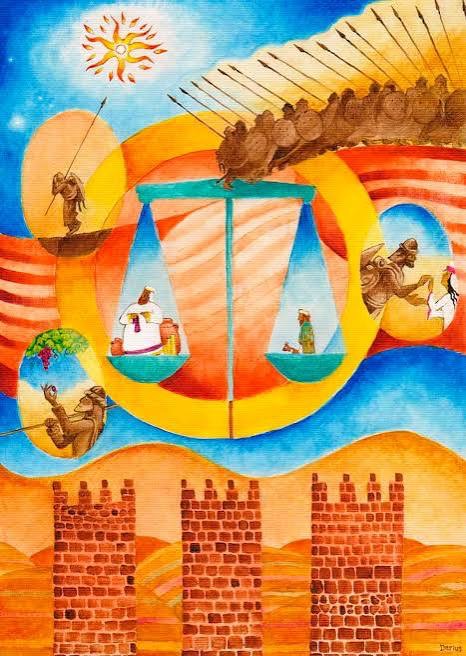
Shoftim comes with something quieter and perhaps more revolutionary: a blueprint for justice, limited government, moral leadership, the separation of powers, and the principle that no ruler—not a king, president, prime minister, judge, general, rabbi, or billionaire—is above the law.
These words are more than three thousand years old, yet they read as though Moses had access to this morning’s news.
A SYNOPSIS OF PARASHAT SHOFTIM
――――― ◆ ❧ ◆ ―――――
Shoftim means “judges.” The parsha opens with the command to establish judges and officers in every community:
――――― ◆ ❧ ◆ ―――――
“Justice, justice shall you pursue.”
— DEUTERONOMY 16:20
――――― ◆ ❧ ◆ ―――――
The repetition of the word justice is deliberate. The Torah does not merely tell us to admire justice, discuss justice, campaign on justice, or apply justice when it is convenient. We are commanded to pursue it—and to pursue it justly.
Shoftim then constructs a remarkably sophisticated system of governance. It defines the responsibilities of judges, priests, prophets, and kings. Authority is divided because concentrated power, even when placed in seemingly capable hands, eventually becomes dangerous. The Torah understood long before modern political philosophy that human beings should not be trusted with unlimited power—especially those who are convinced they are the only people qualified to possess it.
Judges must be impartial. They may not accept bribes or favor the powerful. Difficult cases are referred to a higher court. False witnesses are held accountable. Cities of refuge are established so that justice can distinguish between intentional murder and accidental death.
The Torah permits Israel to appoint a king, but then immediately limits him. He may not accumulate excessive wealth, horses, or wives—the ancient world’s equivalent of money, military power, and personal indulgence. Most importantly, the king must write his own Torah scroll and read from it throughout his life:
――――― ◆ ❧ ◆ ―――――
“So that his heart will not be lifted above his brothers.”
— DEUTERONOMY 17:20
――――― ◆ ❧ ◆ ―――――
The king may sit on a throne, but he remains a brother.
Shoftim also regulates warfare. Before battle, Israel must offer terms of peace. Soldiers who have built a home, planted a vineyard, become engaged, or are overcome by fear may be excused from combat. Even during war, fruit trees may not be needlessly destroyed. The Torah recognizes that there are times when evil must be confronted, but it refuses to allow warfare to erase our humanity.
Finally, when a murder occurs and the perpetrator is unknown, the elders of the nearest city must perform a solemn ritual and declare that they did not shed the blood or ignore the victim. The message is unmistakable: leaders are responsible not only for the harm they personally cause, but also for the conditions they permit to grow around them.
Shoftim is therefore not simply about courts and kings. It is about accountability. It teaches that justice must restrain power, learning must guide leadership, humility must accompany authority, and every society must accept responsibility for the moral climate it creates.
THE CROWN IS NOT A PERMISSION SLIP
――――― ◆ ❧ ◆ ―――――
The Torah does not object to leadership. It objects to leadership that begins to worship itself.
Maimonides taught that a king should carry the burdens, complaints, and difficulties of the people as a caregiver carries an infant. He must protect the dignity of the humble, speak gently to the community, and remain merciful toward both the great and the small.
That is quite a job description.
The Jewish understanding of humility is often misunderstood. Humility does not mean weakness. Moses was not timid. David was not passive. Ben-Gurion was certainly not shy about expressing an opinion. Humility does not require a leader to deny his abilities. It requires him to remember that other people matter as much as he does.
Ben Zoma was a prominent Jewish sage who lived in the Land of Israel during the late 1st and early 2nd centuries CE. asked, “Who is honored?” His answer was not the person with the largest office, the longest motorcade, or the most followers. It was the person who honors others.
True humility does not mean holding ourselves low. It means holding others high.
As you know I often quote Rabbi Jonathan Sacks (may his memory be a blessing) who remains one of my favorite contemporary torah scholars, he often emphasized that the Torah’s king must remain a student. He said “The leader cannot delegate the responsibility to read, think, learn, and remember. Advisors may advise, experts may inform, and generals may recommend, but the person who holds the lives of others in his hands must never stop learning”.
To me, that is the difference between a politician and a statesman. A politician studies the polls. A statesman studies history. A politician asks what will win the next election. A statesman asks what will protect the next generation.
I am of the belief that the best leaders understand that wisdom is not something we finish acquiring. It is something we must continually pursue.
WHAT THIS MEANS FOR ISRAEL
――――― ◆ ❧ ◆ ―――――
Israel lives in a neighborhood where weakness is rarely rewarded and hesitation can be fatal. It must defend its citizens against enemies who openly seek its destruction. It must confront missiles, drones, terrorism, nuclear ambition, and the long reach of Iran’s proxies. No serious person should ask Israel to ignore threats that no other nation would tolerate.
Shoftim does not command Israel to be defenseless. It commands Israel to remain righteous while defending itself.
That may be the more difficult battle.
The Torah recognizes the necessity of war, but it surrounds warfare with moral boundaries. Peace must remain the preferred destination. Innocent life must retain its value. The natural world must not be destroyed without purpose. Military power must serve life rather than become an object of national worship.
Israel’s strength has never rested solely in aircraft, intelligence, cybertechnology, or missile defense—although I remain grateful for all four. Its deepest strength is the conviction that power is accountable to something higher than power.
Israel is a democracy at war. Its citizens debate government policy in cafés, in the Knesset, in courtrooms, on television, and—because they are Israelis—simultaneously and at considerable volume. Yet that public disagreement is not a national weakness. It is evidence that the state remains alive, free, and morally engaged.
Iran’s rulers demand obedience in the name of religion. Israel’s democracy permits argument in the tradition of religion. Judaism has never feared questions. Our greatest texts are filled with disagreements carefully preserved for future generations. We do not erase the minority opinion; we place it on the same page.
That is one of the great differences between faith and fanaticism. Faith can live beside questions. Fanaticism cannot survive them.
Shoftim reminds Israel that military victory alone is not enough. A Jewish state must also pursue justice, restrain power, protect the vulnerable, and remain humble enough to examine its decisions. Israel must be strong enough to defeat its enemies and wise enough not to become like them.
WHAT THIS MEANS FOR THE UNITED STATES
――――― ◆ ❧ ◆ ―――――
America’s founders understood something Shoftim taught centuries before the Constitution: power must be divided because human beings are imperfect.
Executive, legislative, and judicial authority were separated not because the founders expected leaders to dislike one another—although history has certainly fulfilled that expectation—but because liberty requires institutions capable of restraining one another.
Today’s progressive Democratic movement increasingly seek to weaken these boundaries—by restructuring institutions, diminishing judicial independence, or concentrating greater authority in the executive branch—because they dislike current political or judicial outcomes. Shoftim warns us strongly against this temptation. The separation of powers is not an inconvenience to be discarded when it frustrates our agenda; it is the safeguard that protects everyone when power eventually passes to those with whom we disagree.
Today, the traditional parties are fracturing because many Americans no longer believe those institutions are listening to them. Voters feel ignored by party establishments, trapped between ideological extremes, and exhausted by a political culture that treats compromise as surrender and civility as a suspicious foreign practice.
But the answer to a struggling democracy is not less democracy. It is better leadership within democracy.
Shoftim tells us what that requires: honest judges, restrained executives, courageous critics, truthful witnesses, learned leaders, and citizens committed to justice even when justice does not favor their side.
“Justice, justice shall you pursue” DEUTERONOMY 16:20 means that our methods matter as much as our objectives. We cannot defend the Constitution by ignoring it. We cannot preserve truth by spreading convenient falsehoods. We cannot heal national division by humiliating half the country.
Democracy depends upon losers accepting lawful outcomes and winners remembering that victory does not make them infallible. An election grants authority for a season; it does not confer sainthood.
The leaders America needs will not be those who tell us we are always right and our neighbors are always wrong. They will be those willing to remind us that we share a country, a future, and an obligation to one another.
The Torah’s king carries a scroll so that his heart will not rise above his brothers. Perhaps every elected official should carry something similar. If a Torah scroll is impractical, a pocket Constitution would be a promising start.
WHAT THIS MEANS FOR OCEAN REEF
――――― ◆ ❧ ◆ ―――――
Shoftim also speaks to communities like ours because leadership does not begin in Jerusalem or Washington. It begins wherever people gather and decide how they will live together.
Ocean Reef is more than beautiful homes, boats, golf courses, palm trees, and an impressive number of opinions about dinner reservations. It is a community built on relationships, shared responsibilities, faith, philanthropy, and trust.
Justice within a community means listening before deciding. It means considering how a decision affecting a few may ultimately affect everyone. It means recognizing that authority is not ownership and service is not status.
Whether we serve on a board, lead a congregation, chair a committee, support a charitable organization, or simply help a neighbor, Shoftim asks the same question: Are we using our position to elevate ourselves or to elevate others?
At Ocean Reef, we are blessed with extraordinary resources. But our greatest wealth is not what appears on a financial statement. It is the willingness of people to give their time, experience, faith, compassion, and generosity for the benefit of the entire community.
Our Chapel and Fellowship Center offers a living example. Four congregations, different traditions, shared sacred space. We do not surrender our individual beliefs. We honor one another through them. We demonstrate that unity is not uniformity. It is the decision to stand together without demanding that everyone stand exactly alike.
That is humility in practice. That is justice made personal. And in a divided world, it may be one of the most important sermons we ever preach.
FINAL REFLECTION: THE MONTH OF RETURN
――――― ◆ ❧ ◆ ―――――
This Shabbat arrives with the beginning of Elul, the sacred month of reflection, mercy, and return. The shofar begins to call us—not yet with the majesty of Rosh Hashanah, but with the quiet insistence of an alarm clock for the soul.
Elul asks us to look inward before we look outward.
It is easy to identify arrogance in presidents, prime ministers, ayatollahs, judges, and political parties. It is harder to recognize it at our own dinner table. We can diagnose the moral failures of nations with remarkable precision while overlooking the apology we owe someone down the hall.
Shoftim reminds us that every person governs a small kingdom. We rule our words, our choices, our homes, our businesses, our relationships, and the influence we have upon others.
We may never command an army or sit upon a throne, but each of us possesses power. A word can encourage or wound. A decision can include or exclude. A moment of patience can prevent an argument. An act of kindness can restore someone’s faith in the world.
The Torah does not ask us to solve every conflict before sundown. That is fortunate, because Washington, Jerusalem, Tehran, and even a few committee rooms at Ocean Reef may require additional time.
It asks us to begin.
To pursue justice twice—once in the world and once within ourselves.
To learn before speaking.
To listen before judging.
To remain strong without becoming hard.
To carry responsibility without believing we are superior to those we serve.
And to remember that the real measure of leadership is not how many people stand when we enter a room, but how many people stand taller because we were there.
The world is unsettled, but it is not without direction. Shoftim places the compass back into our hands. Its needle points toward justice, humility, wisdom, and hope.
The rest is our journey.
CLOSING PRAYER
――――― ◆ ❧ ◆ ―――――
Eternal God, Source of justice, wisdom, and peace, grant our leaders the courage to defend what is right, the humility to listen, the wisdom to continue learning, and the compassion to remember every life entrusted to their care.
Protect the people of Israel, the United States, and all innocent people endangered by war. Comfort those who mourn, heal those who are wounded, strengthen those who serve, and guide the nations away from destruction and toward lasting peace.
Bless the people of Iran who yearn for freedom, dignity, and a future without fear. Help all who possess power remember that authority is a sacred trust, never a personal possession.
As we enter the month of Elul, open our hearts to reflection, forgiveness, and return. Teach us to pursue justice through just means, to honor those with whom we disagree, and to bring greater kindness into our homes and communities.
May we be strong without arrogance, faithful without intolerance, and hopeful without denying the challenges before us.
May the work of our hands bring healing, may the words of our mouths bring understanding, and may our lives become instruments of justice, humility, and peace.
Amen
Shabbat Shalom
Michael L Weiss Ph.D., HCCP
Congregation Ocean Reef
August 14, 2026/ 2 Elul 5786
Support Our Congregation
Please consider supporting our congregation so we may continue offering meaningful programs and community events. Your generous gift helps make this work possible.
Donate Now