
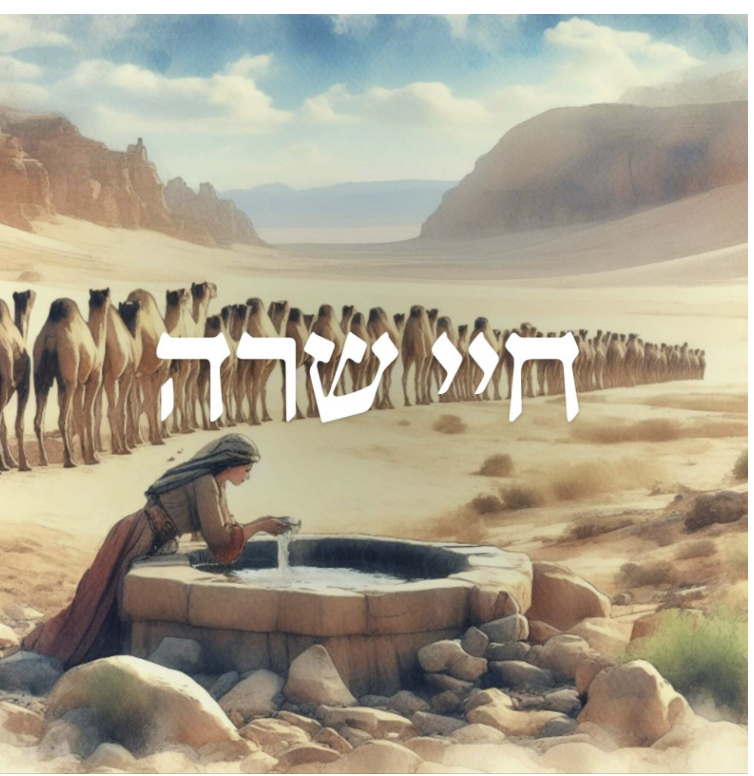
Parshat Chayei Sarah (חיי שרה)
November 14, 2025 | 23 Cheshvan 5786
Genesis 23:1 – 25:18
Welcome Back to Our Season of Faith
The season has begun at Ocean Reef, and so have our Friday Night Shabbat Services. We welcomed back our community in grand style, with Rabbi Anne accompanied by our Cantorial Soloist Adina, filling the Chapel with warmth and harmony. The day began with our new monthly Lunch-and-Learn class jointly led by Rabbi Ann and Chaplain Dan — a beautiful act of unity and purpose. Services were uplifting, the music inspirational, and the prayers heartfelt.
Then came the sacred Jewish ritual known as the post-service greeting line. There I learned many things. Some told me my welcome-back messages were too long (imagine that!). Others felt the Yellow Tail fish at dinner wasn’t good, while others loved it; some found the braised short ribs boring, while others swore they were divine. One congregant didn’t like the dessert, four congregants wished the live music had lasted longer; three members told me they wanted more old songs, others newer ones.
Welcome to Congregation Ocean Reef … it’s good to be home!
A Brief Synopsis of the Parsha
This week’s Torah portion, Chayei Sarah, opens with the passing of Sarah, but the story is really about what follows: how faith, love, and legacy move forward. In his grief, Abraham does something extraordinary. He purchases the Cave of Machpelah in Hebron as a burial site for his beloved wife. On the surface, it’s an act of mourning. But in truth, it’s far more profound, it is the first legal claim by the Jewish people to the Land of Israel.
Now I ask you to think about this in today’s global discussions on the legitimacy of the State of Israel— this is a significant historical fact that can’t be ignored or overlooked. A documented and valid claim to the land which, in today’s world where history and truth are so often replaced by social media manipulation and mistruths, this event establishes something extraordinarily significant.
Long before Israel united its tribes, before Babylon and Persia, before Greece and Rome, before the birth of Islam, the Holy Roman Empire, the Ottoman Empire and the modern debates over Palestinian claim to land — Abraham’s purchase established something eternal. It was not conquest, but covenant. Abraham set a precedent of moral ownership and faith-based legitimacy. The land was no longer just promised; it was possessed; through integrity, not violence.
From there, the story turns to continuity. Abraham sends his trusted servant, Eliezer, to find a wife for Isaac, ensuring that the covenant not only has land, but lineage. At a well in a distant land, Eliezer prays for guidance and finds Rebekah, whose instinctive kindness and strength reveal that divine purpose often hides in simple acts of goodness. Through her, faith becomes generational, renewed by love and grounded in compassion.
The message of Chayei Sarah is timeless: life, love, and faith are not accidents of birth but choices of character. Abraham teaches us that holiness is built through action, through the courage to claim what is right, to honor what is sacred, and to ensure that what we begin in faith is continued by those who follow.
A Marriage, a Mission, and the Meaning of “We”
So if Chayei Sarah is a story of transition, continuity, and a love that endures, what then is the meaning of a marriage? I speculate if you ask any couple, you’ll get a different answer, possibly even from the wife and husband.
So in my mind, I began to reflect on a question: how many beings are there in a union or marriage? Again, this question is not random, it pertains to what the Torah is about to explore. But to my question, I would speculate that most would say two, right? Maybe three if you count God — and perhaps four if you include in-laws who think they’re God. But the truth, as this week’s parsha reveals, is that there’s another presence in every lasting union, the “we.”
This mysterious “we” is born somewhere between I and you. It is fragile yet holy, intangible yet deeply real. And as Chayei Sarah unfolds, we see this sacred “we” begin not only between Isaac and Rebekah, but between individuals and nations, families and communities, leaders and those they serve.
When Abraham’s servant Eliezer prays for success and finds Rebekah at the well, the Torah teaches that divine purpose often manifests through human kindness. The “we” that forms at that moment becomes the bridge from individual faith to collective destiny.
Eliezer at the Well: A Lesson in Character and Covenant
After Sarah’s passing, Abraham, the visionary patriarch sends his trusted servant Eliezer on a mission not just to find a wife for Isaac, but to continue the covenant God had promised. Abraham doesn’t hand Eliezer a list of eligible families or social requirements. Instead, he entrusts him to find someone of character — a person whose kindness and humility reflect the values that will sustain the future of the Jewish people.
So Eliezer, perhaps feeling the weight of this holy assignment, does what so many of us do when faced with impossible odds, he prays. standing by a well outside the city, he asks God for a sign: “Let the woman who offers me water, and who also waters my camels, be the one You have chosen.”
And then it happens. Before he finishes his prayer, Rebekah appears, not a princess or a prophet, but a young woman whose heart overflows with kindness. Without hesitation, she draws water for a stranger and then for ten thirsty camels (a feat of endurance in itself!).
It’s easy to read this as a sweet story or divine coincidence. But the Torah’s lesson is far richer. Rebekah’s gesture is not about etiquette, it’s about empathy. She doesn’t wait to be asked; she anticipates need. She acts with compassion before calculation, with generosity before judgment.
In that moment, Eliezer recognizes something eternal: that love and by extension, covenant, begins not with grand gestures but with small acts of goodness.
The Torah teaches that kindness is the language through which God continues creation.
Eliezer didn’t find Rebekah because of luck or logic; he found her because he looked for goodness, and goodness answered.
And perhaps that’s the real well we are all meant to draw from: one of empathy, patience, and purpose. In every generation, God’s covenant is renewed not through wealth or power but through compassion that flows freely, one cup of water at a time.
Lessons for Israel: The Covenant of Continuity
In Israel today, Chayei Sarah resonates with profound immediacy. The first Jewish land purchase reminds us that our connection to the Land of Israel is not just emotional or political, it is theological, historic, and divinely sanctioned. Abraham paid for that land in silver, not in conquest, setting a precedent of moral ownership rooted in faith and integrity.
But the parsha also challenges Israel’s leaders and citizens alike: to hold fast to the sacred “we” that binds the Jewish people, even amid division. Israel is home to a remarkable diversity, religious and secular, Ashkenazi and Mizrahi, right and left, immigrant and native-born. The miracle of modern Israel is not only survival, but coexistence; not only innovation, but identity.
Yet unity is not automatic, it is built through shared responsibility. We can protect Israel not only by defending its borders, but by defending its soul: through ethical governance, compassion toward one another, and the preservation of the moral clarity that Abraham embodied.
The covenant endures because it is defended — not by armies alone, but by conscience, compassion, and the conviction that God’s promise remains our collective charge.
Lessons for the United States: Rebuilding the “We”
In America, too, our “we” has frayed. The social fabric once held together by shared purpose and moral grounding has begun to unravel in the pull of self-interest and outrage. Yet, just as Rebekah’s simple act at the well restored faith in humanity, we are called to restore empathy in our public life.
To be Jewish in America today is to stand at a well of moral choice. Will we offer water or walk away?
Our nation was built on covenantal ideals drawn from scripture: that all are created equal, endowed with purpose, and bound to one another in liberty and justice. But liberty without empathy is arrogance; justice without compassion is cruelty.
As Jews and Americans, we have a responsibility to:
- Rebuild the “we” by modeling civility and dialogue, even with those we disagree with.
- Protect our communities and institutions from hate and division by standing together, synagogues, churches, and civic groups alike.
- Teach our children gratitude for the freedoms we enjoy, and the vigilance needed to preserve them.
- Speak up when faith, freedom, or truth are mocked or dismissed.
The Torah reminds us that leadership is about serving the common good. When we think of others first, when we defend the dignity of all, when we give voice to compassion amid the noise of division, we uphold both the American and the Jewish covenant.
If Israel is the wellspring of our faith, America remains the vessel through which our values find freedom. Both must be guarded with courage, civility, and love.
Lessons for Ocean Reef: The Sacredness of Community
And so, we come home, to our small but mighty “tribe by the sea.” Ocean Reef may not be biblical, but it is deeply covenantal: a fellowship of purpose, philanthropy, and shared faith. Here, we practice what the Torah teaches in microcosm — building unity not through uniformity, but through generosity of spirit.
Our “well” isn’t in the desert; it’s in the gardens, the Chapel, and the quiet gestures of care that define our community. When one of us mourns, we show up. When one of us celebrates, we lift the glass. When we give, whether through a plaque, a memorial, or a donation we add our drop to the well of continuity.
Yet even here, preservation takes work. What can we do to strengthen this sacred “we”?
- Mentor the next generation of leaders and givers so that the mission endures.
- Build bridges between our Chapel, our Congregation, and our broader Fellowship Center, seeing them not as silos, but as sacred partners.
- Nurture gratitude for what we’ve built, while ensuring it remains open, inclusive, and inspiring.
- Keep humor and humility at the heart of our community life. They are the best tools for unity ever invented.
Abraham’s “purchase” reminds us that holy ground is made, not found. Here at Ocean Reef, we continue that work — creating sacred space through acts of generosity, faith, and fellowship.
Continuing the Lesson
In recent weeks we’ve spoken of trust (Lech Lecha), courage (Vayeira), and balance (Noach). Chayei Sarah ties them all together, reminding us that holiness lies not in beginnings alone, but in what we sustain.
The covenant was never meant to be a one-time gift; it is a renewable promise, a partnership renewed through kindness, vigilance, and shared faith. The “we” endures when we keep showing up: for each other, for Israel, for America, and for our own sacred community.
So may we each find our well this week — and offer water freely.
A Prayer for Our People and Our Place
יִתְגַּדַּל וְיִתְקַדַּשׁ שְׁמֵהּ רַבָּא.
May the One who makes peace in the heavens bring peace to us, to Israel, to the United States, and to our community at Ocean Reef.
Oseh Shalom bimromav, Hu ya’aseh shalom aleinu, v’al kol יִשְׂרָאֵל, וְעַל כָּל יוֹשְׁבֵי
And Finally… About Next Month’s Dinner
As for our next gathering rest assured, we’re taking bold culinary steps forward. After hearing every possible opinion about the last dinner — from “the fish was too fishy” to “the meat was too meaty” we decided it’s time for a new strategy.
We’ll be unveiling a completely new menu next month — one that I’m confident will delight many, mystify a few, and for others, ensure that I remain firmly in the dog house… possibly sharing a room there with the chef.
Yes, there will be something for everyone — gluten-free, dairy-free, and possibly flavor-free (kidding… mostly). I’ve even suggested a new dish called “Braised Opinions,” served warm with a side of “Everyone’s a Critic.”
We’re also tackling the music: new songs, old songs, songs that make you want to dance — and maybe (its a surprise), a bigger program designed to delight everyone who attends. For those who prefer the classics, fear not: “Hava Nagila” is safe. For those who want something new, well… let’s just say, Adina is exploring the works of Billy Joelstein.
But beyond the menu and melodies, the truth is this, it’s the laughter, the kvetching, and the coming together that make it all worthwhile. After all, a little mystery, a touch of melody, and a hint of brisket diplomacy never hurt a congregation.
So stay tuned — and bring your appetite, your patience, and maybe a sense of humor.
Shabbat Shalom — it’s good to be home.
Michael L. Weiss, PhD., ABD, HCCP
President, Congregation Ocean Reef
Support Our Congregation
Please consider supporting our congregation so we may continue offering meaningful programs and community events. Your generous gift helps make this work possible.
Donate Now