
Parshat Vayeitzei
Becoming the Ladder
November 28, 2025 | 27 Cheshvan 5786
Genesis 28:10-32:3
Before you dive into this week’s Parshat journey, let me offer a small and friendly disclaimer: yes, Parshat Vayeitzei inspired me to write a commentary that’s a bit longer than usual. But in my defense, when the Torah hands us a chapter this rich—filled with ladders stretching to heaven, angels ascending and descending, dreams, promises, love stories, family drama, and divine purpose—well… you try summarizing that in two paragraphs.
And truly, could there be a more fitting week for a full-bodied, super-sized Parsha? With everything happening at Ocean Reef—our Night of Unity, the Museum of the Bible gift to the Chapel, the Food Drive, the endless caravan of golf carts (which, frankly, feel like our modern-day camels), and a community spirit that could set the Keys aglow—Vayeitzei speaks right to our moment. It reminds us that even when life feels busy or overwhelming, holiness shows up exactly where we stand.
So settle in, pour something warm (or celebratory—no judgment), and enjoy this week’s deep, meaningful, and yes—joyfully lengthy—exploration of Vayeitzei.
If Torah is nourishment for the soul, then this week’s portion is a seven-course tasting menu.
Jacob Steps Into His Destiny
Parshat Vayeitzei arrives like the second act of a great spiritual drama we’ve been following in recent weeks. If Toldot revealed the tension of duality within Jacob and Esav, and Chayei Sarah highlighted the power of compassion and character in shaping the future, then Vayeitzei thrusts Jacob into the wider world—alone, vulnerable, searching—and begins his transformation from a man of potential to a man of purpose.
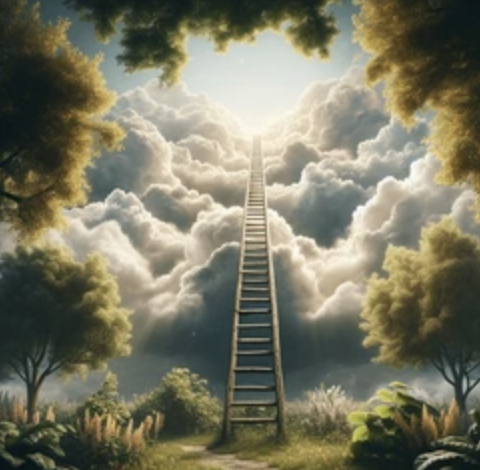
Jacob flees from Esav after the “creative acquisition” of the blessing. Exhausted and frightened, he collapses under the night sky using a stone as a pillow—a choice that confirms our patriarchs were not always paragons of ideal sleep habits. And it is here, somewhere between fear and fatigue, that he dreams the dream that will forever define him: a ladder rooted in the earth, reaching toward the heavens, with angels ascending and descending.
G-d promises Jacob protection, descendants, land, and a future. What Jacob does not yet understand is that the ladder is not merely a vision—it is an assignment. One day, he must become what he sees.
Jacob then arrives in Haran, where he encounters Rachel at the well. Previously in our commentaries, I’ve noted that wells in the Torah rarely serve as neutral ground. They are where love stories unfold, destinies shift, and G-d quietly nudges the narrative forward. True to form, Jacob falls in love, only to become entangled in Lavan’s web of deception, switched brides, and livestock negotiations that would confound even seasoned auditors. Through these trials, Jacob grows—morally, spiritually, and emotionally. He becomes a father, a leader, and a man who, while imperfect, begins to understand what G-d expects of him.
After years of service, Jacob escapes Lavan and heads home. And then something remarkable happens: the angels appear once again—not in a dream, but in daylight. This time Jacob meets them awake, upright, and transformed. He names the place Machanayim, “two camps,” where the ordinary and the divine seem to touch.
From Dreamer to Ladder
Jacob’s second encounter with angels could not be more different from the first. In the dream, the angels did not interact with him. They moved past him without acknowledgment. He was a spectator to the sacred, passively observing divine activity. But now, years later, the angels approach him directly. They see him—and he sees them.
The ladder was never meant to be a mystical screensaver. It was a metaphor for a life lived with integrity and moral courage. It was a symbol of a human being who brings heavenly values into earthly behavior. It was G-d’s way of telling Jacob: “One day, you will be the bridge between heaven and earth. One day, your actions—not your dreams—will elevate the world.” And slowly, Jacob grows into that calling.
The Tower Versus The Ladder
There is a deeper layer here that speaks directly to something I’ve emphasized often in past commentaries: the Torah loves duality. It teaches us through contrasts—pairs of competing forces that reveal truth through tension. We saw it in Toldot, where Jacob and Esav embodied two divergent paths of destiny. We saw it in Chayei Sarah, where the negotiation for Sarah’s burial plot balanced grief with legacy. In Vayeira, Abraham wrestled with compassion for strangers even as he confronted G-d over justice. And long before that, the dove and raven emerging from Noah’s ark embodied hope versus despair.
The Torah repeatedly frames its teachings through such dualities—light and darkness, justice and mercy, conflict and reconciliation, fear and faith. And Vayeitzei adds a new pair to this ancient pattern.
The Tower
In the Torah, the only other structure described as having its “head in the heavens” besides Jacob’s Ladder is the Tower of Babel. Yet the contrast (duality) between them could not be sharper. The Tower was humanity’s attempt to storm the heavens through ambition, ego, and the desire to “make a name” for themselves. The Ladder is G-d’s invitation for partnership—not by climbing upward into heaven, but by bringing heaven downward into human life.
The Tower represents ego, fragmentation, and the collapse of community.
The Ladder represents humility, connection, and the bridging of worlds.
Babel divides; the Ladder unites.
Babel confuses; the Ladder clarifies purpose.
Babel collapses under human arrogance; the Ladder endures through divine intention.
Just as earlier dualities— the Tower and the Ladder remind us that Judaism does not fear complexity. It teaches us to confront competing values and choose the one that elevates, heals, and brings holiness into the world.
The Tower asks, “How can we rise above others?”
The Ladder asks, “How can we lift the world with us?”
To me, this is the beating heart and message found in Vayeitzei.
When Heaven Touched Ocean Reef
Last week’s Night of Unity at the Chapel was nothing short of extraordinary—a moment where our Chapel became a living echo of Jacob’s Ladder. For a brief, sacred time, heaven and earth felt astonishingly close.
We had the privilege of witnessing Ambassador Michael Oren and Dr. Os Guinness—one Jewish, one Christian—engage in heartfelt and profoundly honest dialogue about faith, identity, and the moral foundations that bind us as one extended family. Their reflections were not competing monologues; they were harmonies. Both spoke from their traditions with clarity and conviction, yet with a shared recognition that Jews and Christians are bound by a deep spiritual lineage.
Guiding this remarkable exchange with pastoral wisdom and steadiness was Dr. Dan Meyer, our Chapel’s Chaplain in Residence, who served as moderator. With his calm presence and thoughtful questions, Dr. Meyer created a sacred space for these two towering thinkers to speak freely and with vulnerability. His leadership elevated the evening from conversation to revelation.
One unforgettable moment came when Dr. Guinness discussed how the Founding Fathers of the United States drew directly from Torah principles to craft the Constitution. Concepts such as covenantal society, checks on power, moral accountability, and the inherent dignity of every human being were not invented in Philadelphia—they were inherited from Sinai. Ambassador Oren expanded on this foundation through the lens of the Hebrew prophets, whose moral clarity continues to shape modern ethical thought.
Sitting among our community members—Jews and Christians together—I felt the room lift. The Ladder was not metaphorical that night we climbed it together.
Meeting the Ancients Face to Face
Just a mere 12 hours later, standing before the Dead Sea Scrolls at the Museum of the Bible in Washington DC, my wife Cheryl and I experienced that same profound sense of sacred continuity. These fragile manuscripts—preserved against every conceivable historical threat—are the earliest surviving witnesses to our sacred texts. Their creators could not have imagined our world, yet their devotion still sustains us.
These scribes built rungs on Jacob’s Ladder through ink, prayer, and faith. Their work allowed the teachings of Jacob, the Ladder, and the covenant to survive empires, dispersions, and centuries. And in that quiet exhibit hall, I understood that Ocean Reef, too, has become one of the rungs—a community reaching for heaven while remaining grounded in acts of kindness.
Israel and the Ladder
Israel today stands exactly where Jacob once stood: wrestling with its destiny and challenges, navigating the tension between faith and fear, promise and peril, calling and complexity. Like Jacob returning to face Esav, Israel faces immense pressures yet continues forward—sometimes limping, often courageous, always anchored in purpose.
From a Reform perspective, Israel is called to embody the Torah’s moral vision—justice, dignity, protection of the vulnerable, and pursuit of peace.
From a Conservative perspective, Israel carries the ancient covenantal obligation to defend the Jewish people, ensure survival, and safeguard the homeland with vigilance and sacrifice.
Most of us live somewhere between these poles, recognizing Israel’s imperfections yet honoring its resilience and purpose. Israel climbs the Ladder not by claiming perfection, but by continuously wrestling with ethical dilemmas, defending its people, and striving to uphold its deepest values. Like Jacob, Israel refuses to let go of the blessing—even when it must struggle to keep it.
The United States and the Ladder
If Israel mirrors Jacob’s spiritual journey, the United States mirrors his moral crossroads. Our national discourse today is often loud, divided, and dangerously reminiscent of Babel—ambition without humility, noise without purpose.
Yet at America’s core lies a profound biblical inheritance. The Founding Fathers—Washington, Adams, Jefferson, Madison—read the Hebrew Bible as a political and moral guide. Covenant, limits on power, human dignity, rights endowed by G-d rather than rulers—these are Torah ideas woven into the Constitution.
America’s greatness has always been built on an aspirational ladder: liberty, justice, equality, responsibility. But ladders need caretakers. They require guardianship, humility, and the courage to seek higher ground even when division threatens to pull us downward.
If America chooses Babel—division fueled by ego—the structure weakens.
If America chooses the Ladder—values anchored in faith and shared purpose—the nation rises.
The stakes are high, and the choice is ours.
Ocean Reef: A Modern Machanayim
Here at Ocean Reef, nestled between sky and sea, we have the rare privilege of belonging to a community that reflects the very best of Jacob’s Ladder in action. It is a place where heaven and earth seem to touch in quiet gestures and unforgettable moments.
Ocean Reef is not just a collection of homes, golf carts and boats; it is a tapestry of souls who, despite diverse traditions, come together with profound generosity and kindness. Faith communities collaborate. Volunteers appear without being asked. Compassion flows like the tides.
This truth became powerfully evident again this past Monday, when the Chapel—in fellowship with the Ocean Reef Community Foundation—held a food drive in response to the dire and growing need throughout communities in the Keys. Golf carts rolled in one after another. Cars pulled up. Neighbors arrived on foot. Bags, boxes, and donations poured in. No one asked who belonged to which faith—Jewish, Protestant, Catholic, Episcopalian—it simply didn’t matter. Everyone contributed. Everyone gave. Everyone stood together.
In that moment, the Ladder was rooted firmly at the Chapel, and every person who contributed stood on a rung of Jacob’s vision—bridging heaven’s compassion with our neighbors’ very real needs.
And as much as it may sound familiar for me to say, Psalm 133 was felt in its fullest expression: “How good and how pleasant it is when brothers and sisters dwell together in unity.” On Monday, unity was not preached—it was lived.
The same spirit animated our Night of Unity. In the Sanctuary, Jews and Christians gathered as one extended family—learning, listening, and discovering the spiritual roots we share. For that evening, Ocean Reef became its own Machanayim—a place where angels seemed to linger among us.
The Ladder appears here every day: in quiet acts of compassion, in shared worship, in helping hands, in hospitality, and in the grace with which this community cares for one another. When someone comforts a grieving friend, when a neighbor opens their home, when committees work through challenges with patience, when volunteers serve without expectation of recognition, and when our Chapel opens its doors to anyone seeking meaning or community.
Ocean Reef has the rare opportunity to model what the world desperately needs: unity without uniformity, compassion without condition, and fellowship without boundaries. Here, we are called to become the rungs of Jacob’s Ladder—lifting ourselves and each other closer to the divine.
Final Thought
Jacob dreamed the Ladder, but its construction was left to his descendants. The dream is now ours. Every act of kindness becomes a rung. Every moral choice lifts us higher. Every gesture of compassion brings heaven closer to earth.
The Ladder is not merely Jacob’s—it is ours to build, one act of goodness at a time.
May we continue climbing—with purpose, humility, strength, and love.
A Prayer for Peace and Unity
May the One who makes peace in the heavens make peace for us, for all Israel, for America, for our Ocean Reef community, and for all who dwell on earth.
And may all God’s children—of every faith, nation, and background—find the courage to join hands, to stand as one family, and to heal this world with compassion, justice, and love.
Oseh shalom bimromav,
Hu ya’aseh shalom aleinu,
V’al kol Yisrael,
V’al kol yoshvei tevel,
V’al kol banav u’vnotav shel HaKadosh Baruch Hu,
V’imru: Amen.
עוֹשֶׂה שָׁלוֹם בִּמְרוֹמָיו,
הוּא יַעֲשֶׂה שָׁלוֹם עָלֵינוּ,
וְעַל כָּל יִשְׂרָאֵל,
וְעַל כָּל יוֹשְׁבֵי תֵבֵל,
וְעַל כָּל בָּנָיו וּבְנוֹתָיו שֶׁל הַקָּדוֹשׁ בָּרוּךְ הוּא,
וְאִמְרוּ: אָמֵן.
May unity be our calling, peace be our path, and healing be our legacy.
Shabbat Shalom
Michael L Weiss, PhD., HCCP
President, Congregation Ocean Reef
Support Our Congregation
Please consider supporting our congregation so we may continue offering meaningful programs and community events. Your generous gift helps make this work possible.
Donate Now